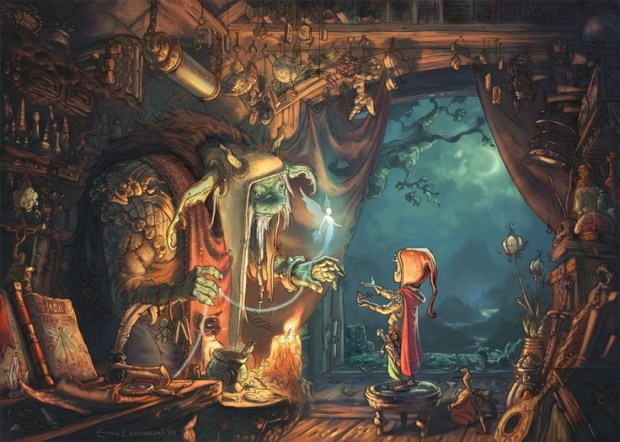
 Magic vs. Science has been a question that fantasy and sci0fi writers have been pondering for quite a long time. The usual trope involves people using science in an under developed country which, to them, seems like magic. I’ve seen this used on episodes of Star Trek, Doctor Who, and various other television shows and movies. It is even considered “one and the same” in the Marvel Cinematic Universe (MCU) as told in Thor.
Science or magic? Or both, for that matter. Anime has a penchant for using magic to power technology, i.e. Knights and Magic, Tenchi Muyo: War on Geminar, The Irregular at Magic High School, and In Another World with my Smartphone, just to name a few. I love to see magic used in this way, it really has a cyber-punk/steampunk feel to it.
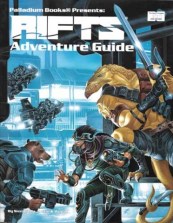 I remember an old Role Playing Game (RPG) I played back in the 80’s (no jokes or comments about my age please) called Rifts. The backstory involved a post-apocalyptic Earth where the ley lines have unlocked dimensional rifts, the rebirth of magical creatures in our modern world, along with the reemergence of mysterious locations like Atlantis, Lemuria, and other mythical places. I remember this picture in the player’s guide of an Elf, wearing cyber-punk tech, trying to hack into a computer. It really covered all angles of magic/technology. That’s the type of genre convergence I like to see.
The way to think about this is as a source of energy. Magic is, in all practical purposes, energy. You can call it mana, psions, or PPE (Potential Psychic Energy per Rifts), it’s still magic. Spells allow magicians, mages, magic casters, etc., to manipulate this energy through spells. In some ways, the use of technology gives the wizards a way to cast their spells faster, more accurate, and more powerful than traditional casting.
The best example for this is in the anime The Irregular at Magic High School. I know, I talk a lot about anime in my blogs, but that’s really to the broad range of genres they use. Anyway, in this anime, magical power is measured in psions or “thought particles” and use Casting Assistance Devices, or CADs, to make it easier to cast certain spells. The CADs are preprogrammed with spells that allows the caster the ability to use spells in rapid succession.
In the movies, the MCU has changed the way we look at mythology. The Asgardians in Thor use magic and science in the same breath. The ability to access this energy lies in their immortal life. When Thor first appeared in the comics, it was told as the ancient Gods coming to the modern age, nothing more. This was retold when the MCU was created and it made so much more sense. These are not beings born of magic, but a race of inter-dimensional beings who used magic to power their science.
“Your Ancestors Called it Magic, but You Call it Science. I Come From a Land Where They Are One and the Same.” — Thor Odinson, Thor
It’s a fine line to walk, especially as a writer. With magic, you can do practically anything in your stories. Magic is an unpredictable and wide-ranging power. However, when it comes to science, anything you create or imagine, you need to base it in science. Think about Star Trek. When the late, great Gene Roddenberry created his series, he wanted to base the technology on practical science. He even spoke with physicists and other scientists to ensure he was basing his stories on what technology in the future could be. I mean, from Star Trek, we got cell phones, digital music and movies, and other tech we see today… And it only took less than 50 years to go from science fiction to science fact.
Steve Jobs once noted that his inspiration for the iPod came from an episode of Star Trek: The Next Generation where music was played by the computer. This is how writers can inspire. Think back to Jules Verne. From 20,000 Leagues Under the Sea to From the Earth to the Moon, submarines and rockets became a reality. Although, I’m still waiting for my H.G. Wells time machine.
As writers, we can let our imagination go and create anything and everything possible. Whether it be science or magic, or both… Use whatever you can to bring your story to life.
# # #
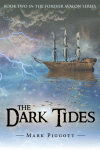 Mark Piggott is the author of the Forever Avalon book series. Forever Avalon is available for purchase as a book/ebook at Amazon. The Dark Tides is available for purchase as a book/ebook at Amazon, Barnes and Noble, and iUniverse publishing. The Outlander War, Book Three of the Forever Avalon series is coming soon.
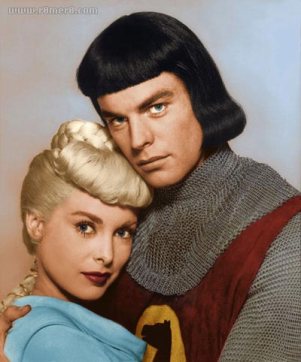 5. Prince Valiant (1954) — Robert Wagner called this film an “embarrassment” but I can’t help loving this movie. First off, I grew up reading the adventures of Prince Valiant every Sunday in the comics, so it’s a part of my own personal history. The plot was your basic “boy vows to become a knight and restore his family honor” gimmick… “After the evil King Sligon exiles his family from Scandia, Prince Valiant (Robert Wagner) vows to become a member of King Arthur’s Knights of the Round Table in order to return his father to the throne. As he travels to Camelot, Valiant discovers the Black Knight, a villain conspiring with Sligon to destroy King Arthur. Under the eye of Sir Gawain (Sterling Hayden), Valiant trains to become a knight, falls for a princess (Janet Leigh) and unmasks the Black Knight (James Mason). This movie had an all-star cast, which is one of the reasons I loved it so much. You just have to get past that awful haircut on Prince Valiant, which is why, I think, Robert Wagner was embarrassed by it.
 4. The Flame and the Arrow (1950) — Burt Lancaster led this fun-filled, acrobatic movie. Set in Italy (not England, for a change), the story revolves around Italian archer Dardo Bartoli (Burt Lancaster), who is waging a war against the Hessians. His grudge against their leader, Count “The Hawk” Ulrich (Frank Allenby), is more than simply political. Long ago, he took away Dardo’s beautiful wife, Francesca. Then, Ulrich returned to steal the couple’s son, Rudi. Incensed, Dardo emerges as a rebel leader who may be able to drive out the Hessians for good. This movie shines solely because of Lancaster. His smile is infectious, and his grit and determination are intoxicating. It’s a fun movie, from beginning to end.
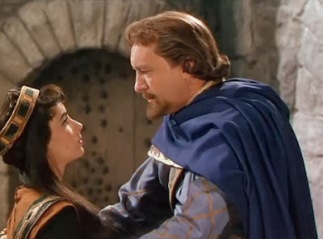 3. Ivanhoe (1952) — This movie had the Hollywood powerhouse of TWO Taylors… Elizabeth and Robert. This is different look using characters from the time of King Richard, just like Robin Hood. Loyal British knight Wilfred of Ivanhoe (Robert Taylor) sets out on a mission to free the kidnapped King of England, Richard the Lionheart (Norman Wooland). The brave Ivanhoe must eventually confront the devious Prince John (Guy Rolfe) and the fierce Norman warrior Brian de Bois-Guilbert (George Sanders), while also juggling the affections of the beautiful maidens Rowena (Joan Fontaine) and Rebecca (Elizabeth Taylor). Again, all-star cast carries this classic movie. Out of all the classics in my list. it has some of the best fight scenes.
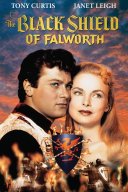 2. The Black Shield of Falworth (1954) — Although this is not one of the more well-known classic medieval fantasy movies, it’s one of mine. Tony Curtis stars as the son of a disgraced knight who – noble by birth, noble by nature – attempts to thwart another noble’s attempts to take the throne of King Henry IV. Janet Leigh stars as the love interest for Curtis. What I love about this movie is how the plot unfolds. Curtis goes from secretly training as a squire to knighthood where he can challenge his enemy directly.
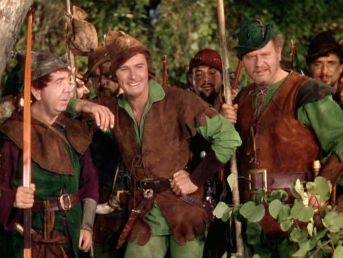 1. The Adventures of Robin Hood (1938) — There be no finer medieval film than this… A perfect cast, magnificent color cinematography and a wonderful musical score highlight this entertaining swashbuckler featuring Errol Flynn, the lovely Olivia de Havilland, Claude Rains, Alan Hale (Skipper from Gilligan’s Island fame), Basil Rathbone and Patric Knowles. The film went on to win three Academy Awards and was the second-highest grossing picture of the year. That says it all about this film. Most of us “baby boomers” kids from the 50s and 60s grew up with this film. You can’t help but love it! Sure, there have been plenty of remakes with non-English actors (hint, Kevin Costner) and that was fabulously mocked by Mel Brooks’ Robin Hood: Men in Tights. It’s like we’ve always said, you can’t beat the original.
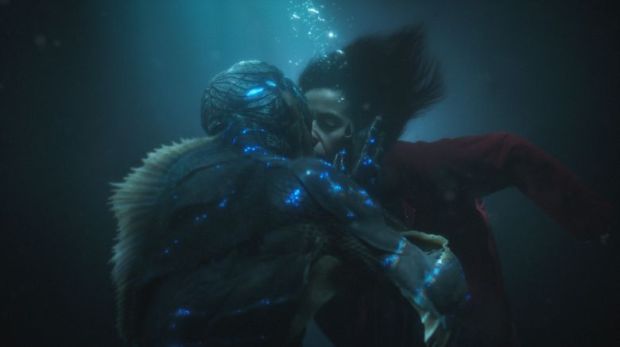 After last night’s win at the 90th annual Academy Awards, Guillermo del Toro’s The Shape of Water is in the spotlight, as is the fantasy genre. It was great to see a writer/director/producer like del Toro win the Best Picture and Best Director Oscar. His vision of other worlds in such wonderfully vivid movies like Hellboy, Pan’s Labyrinth, and Pacific Rim is legendary.
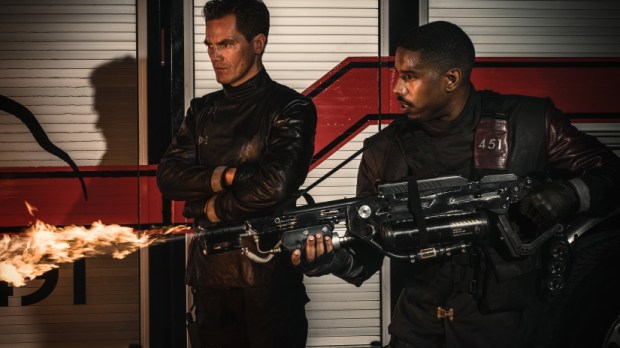 Now, in 2018, HBO is remaking it into a new movie starring Michael B. Jordan and Michael Shannon. It looks amazing, sure to outshine the original. You also got to love the subject matter (burning books, controlling information) in today’s day and age.
 The creatures of fantasy, myth, and legend are as versatile as they are mysterious to a fantasy/sci-fi writer. They can be good or evil, strong or weak. intelligent or half-witted, magical or mutation. The possibilities are endless, and that’s so exciting.
 I think the first time we thought of “virtual reality” was in 1987 when Gene Rodenberry brought us Star Trek: The Next Generation with the latest technology… The Holodeck. We saw a virtual world come to life as Commander Riker stepped on the holodeck, moving from a starship to a forest. There were many such adventures on all the Star Trek series to follow, as the holodeck was used to leave the doldrums of work behind and explore places we’ve never been or seen, from Leonardo Da Vinci’s workshop to a 1920’s crime novel.
 Like science fiction itself, virtual reality gives writers a broad brush to paint with. You can make almost anything possible in virtual reality, but I think medieval fantasy (a.k.a. Lord of the Rings) are the most popular in the genre. Sword Art Online does it best with their virtual reality game ALO (Alfheim Online). Its a wonderful blend of science fiction and fantasy that any fan can slip into easily, whether its the anime or the manga.
 “The language of the Mystic Arts is as old as civilization. The sorcerers of antiquity called the use of this language “spells”, but if that word offends your modern sensibilities, you can call it a “program”; the source code that shapes reality. We harness energy drawn from other dimensions of the Multiverse to cast spells, to conjure shields and weapons, to make magic!” ― The Ancient One, Doctor Strange
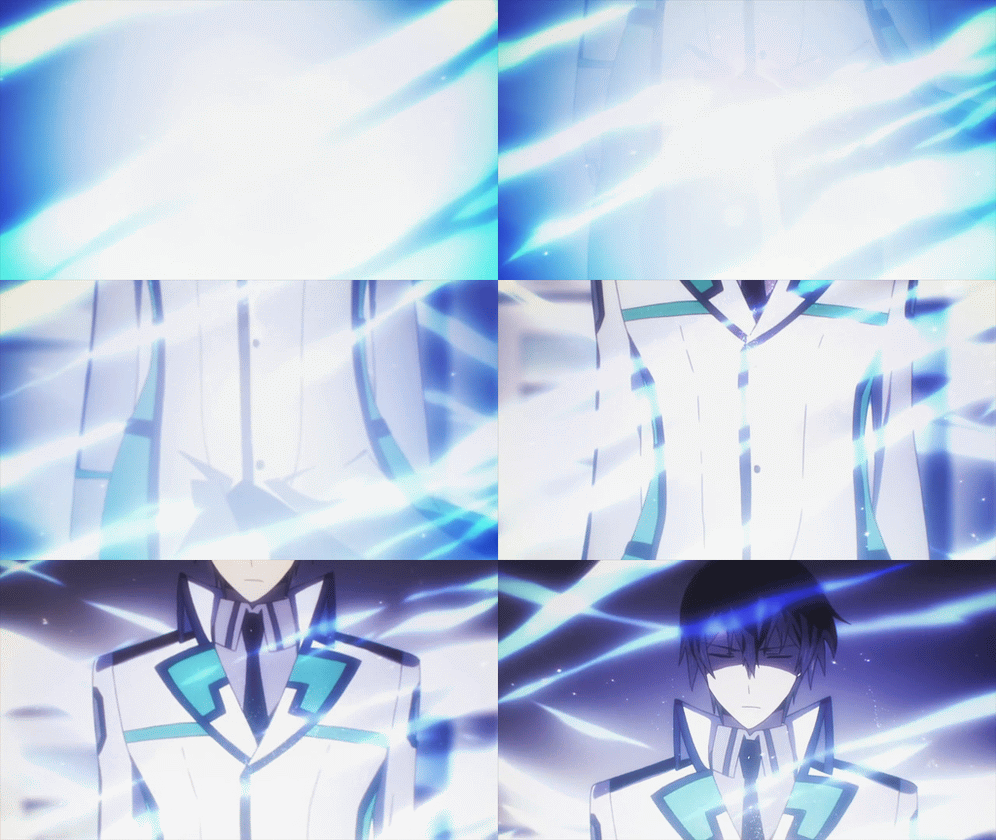 One of my favorite anime’s is “The Irregular at Magic High School” and its use of magic. In the series, magicians tap into psions, non-physical particles that come under the dimension of psychic phenomenon. It taps into this energy through CADs (Casting Assistance Devices) in which spells are programmed through activation sequences. These devices range from something like a wristwatch, smartphone or a gun. Even in a show like this, they still adhere to ancient magic use, like seeing spirits and using spells, to help explain their thoroughly modern system of magic.
 Speaking of the stories, that’s one of the things I truly love in anime. The plots made be similar across different genres, but the stories are incredible versatile and diverse. They combine fantasy, sci-fi, horror, and action/adventure in so many different ways. I also love the “underdog to hero” story in many of them. It’s the heart of most of these stories; specifically, good versus evil. That’s the basis for a lot of them and its the best story there is. Now matter how bad it can get, good wins in the end. They take the morale high ground, even if the main protagonist is a pervert (i.e., High School DxD) or a nobody (i.e., Is it Wrong to pick up Girls in a Dungeon).
 As I’ve said in previous blogs, Hayao Miyazaki is an inspiration and one of my favorite storytellers. He has a brilliance that I aspire too. The art and words of his many wonderful stories give his anime a life of their own. I want my own stories to have the same “magic” as his. In fact, I see that same look of wonder in
  Don’t you hate it when you wake up in the middle of the night, from a vivid dream or something else, and you have the next idea for the book you’re currently writing? As much as I love it when that instantaneous idea of genius hits me; after I wake up, it’s so hard to go back to sleep. I have to write it down before I forget it, or it will rumble around in my head, keeping me awake even longer. That’s the problem you run into as a writer… A lot of sleepless nights. The question is, do I ignore those late night inspirations for the sake of sleep?
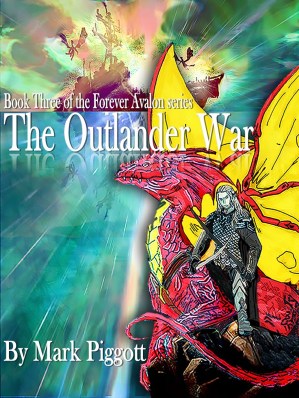 It’s taken me over a year, but I’ve finally finished writing and editing the third book in the Forever Avalon series, The Outlander War. This is the finale of the first trilogy in the series following
  Mark Piggott | Fantasy & Steampunk Author