
I watched Soylent Green the other day, thinking it was appropriate to watch a movie about 2022, where climate change destroyed the world and people were fighting for food, water, medicine, a place to sleep and ate a cracker made from dead humans. Wow, how appropriate, right?
But it got me thinking about the world according to Charlton Heston. As an actor, Heston (1923-2008) was well known for his roles in Biblical movies: The Ten Commandments, Ben Hur, etc. He was quite the versatile actor, starring in disaster flicks, westerns, and war movies. I remember him mostly for the post-apocalyptic, dystopian future movies. These sci-fi classics resonate with anyone who grew up in the 70’s.
I doubt there isn’t a person born before 1970 who doesn’t go to the zoo and look at the apes and chimpanzees and think, “Get your stinking paws off me, you damn dirty ape!” It’s a classic line that makes us all think of Armageddon, the State of Liberty and a world of talking apes. But it also reflected a lot on the time period. In the 70’s and into the 80’s, everyone was worried about destroying the planet, whether through nuclear war, a killer virus, or environmental catastrophe. Now, fast forward to 2020.
When we look out at the world today, these movies seem almost prophetic. It’s funny how movies of the past looked ahead to the future and, some got it wrong, but others… well? I mean think about it. Were in a pandemic that’s cutting off food supply (Soylent Green) and, if left untreated, could very well lead to a zombie apocalypse (Omega Man or I am Legend for the remake) and then, potentially, lead to nuclear war with China and, voila, talking apes (The Planet of the Apes movies).
I know that’s a bit of a stretch, and a bad one at that, but that’s what makes these movies so good. Since Jules Verne first put pen to paper, science fiction and fantasy writers have looked into the future to see potential, both good and bad. It was here that the stories of travelling to the stars, nuclear power, devastating weapons of war, genetically-modified diseases, etc. It’s the essence of these classic movies, and movies like this need a charismatic actor to carry them. That’s where Heston comes in.
These movies all had other memorable moments, actors, cinematography, and special effects, but what stood out the most was Heston. He led these movies all the way, from the pestilence of New York to the deserted sprawl of Los Angeles, to the futuristic Ape City. He commanded the screen and told the story, making it so real for all of us.
That’s why the “World According to Charlton Heston” is a much darker, twisted view of the future, almost like the mainstream media wants us to believe we’re in right now. But I have seen the dark future, through these movies, and this isn’t it. We have better technology, science, and fortitude behind us. We have a better chance of surviving this than the movies would have us believe. After all, it’s all “Hollywood” magic, right?
# # #


 Mark Piggott is the author of the Forever Avalon book series. Forever Avalon is available for purchase as a paperback/ebook at Amazon. The Dark Tides is available for purchase as a paperback/ebook at Amazon, Barnes and Noble, and iUniverse Publishing. The Outlander War, Book Three of the Forever Avalon series is available from Austin Macauley Publishing.
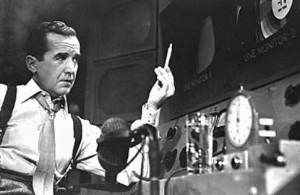 The media are supposed to be the sentinels of the truth. They investigate, question and report on the activities of the government to keep the people abreast of what our public officials are doing. There is no better example of that than Edward R. Murrow (1908-1965). His reporting style focused on facts, not on sensationalism. He never made the story about himself, even when he was pulled into it. One of the best journalism movies out there is George Clooney’s “Good Luck and Good Night” from 2005. It should Murrow’s reporting during the “Red Scare” hearings by Senator Joe McCarthy. You can see the same great examples of journalism in movie’s like “Spotlight” and “All the President’s Men” as well. It doesn’t matter who is in power in Washington, D.C.
 People say that the Vietnam War was lost when the government lost Walter Cronkite. During a trip to Vietnam in 1968, he said, “It seems now more certain than ever that the bloody experience of Vietnam is to end in a stalemate.” That one sentence told the American people that the war was not winnable and, by most accounts, turned many against continuing the campaign. It is said that President Lyndon Johnson was heard to say, “If I’ve lost Cronkite, I’ve lost middle America.” That is the power of journalism.
 Mark Piggott is the author of the Forever Avalon book series. Forever Avalon is available for purchase at
  Mark Piggott | Fantasy & Steampunk Author