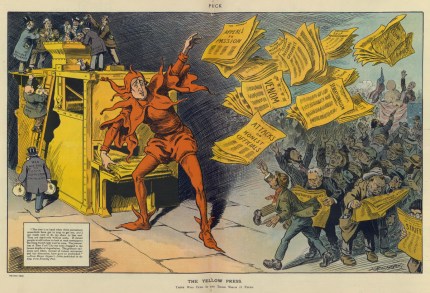
 Have you ever heard of The Yellow Kid? The Yellow Kid was the name of one of the first American comic strip characters that ran from 1895 to 1898 in Joseph Pulitzer’s New York World, and later William Randolph Hearst’s New York Journal. Created and drawn by Richard F. Outcault, this comic strip was ripe with social commentary in newspapers known for sensationalism and extreme editorial reporting. It’s where the term “Yellow Journalism” came from.
In today’s day and age, we are coming back to a new form of “Yellow Journalism” though it’s seen by a lot more people through social media and the internet and packaged in high-definition video and “talking heads” that need plenty of censorship for bad language. I can’t help but see the reflection of the Yellow Kid in today’s media.
For those of you who don’t know, I began my writing career more than 30 years ago as a U.S. Navy Journalist. I attended THE school for military journalism, The Defense Information School (DINFOS) at Fort Benjamin Harrison, Ind. (now, the school resides at fort Meade, Md.). I have written hundreds of news articles, press releases and feature stories on the wonderful men and women of our armed forces. These articles, stories and photographs have been published in small town newspapers, major metropolitan newspapers and military publications.
I told you this because I wanted to talk today about the state of journalism, or actual lack thereof, in the world today. In my opinion, journalism today is not what it’s supposed to be. Journalism is defined as “the activity of gathering, assessing, creating, and presenting news and information.” It is also the product of such activities. That being said, the way it is done by the news media today does not even come close to that definition.
We seem to have crossed that fine line between actual journalism and opinion news, and a lot of it revolves around politics. Now, I’m not trying to get political here, but it’s being abused by both sides. People are comparing what is being reported in the news to Watergate in the 70’s. I can tell you right now, we are nowhere near that.
If you’ve ever read “All the President’s Men” by Bob Woodward and Carl Bernstein, or seen the movie with Dustin Hoffman and Robert Redford, you know how much they went through to get multiple sources to confirm their story about the going’s on in the Nixon Administration. Until they got those sources to confirm, their editor wouldn’t run the story.
Today, it seems like one anonymous source is good enough. The facts are being skewed to fit the agenda, and journalists are not supposed to have agendas. The public relies on these news sources to be the independent watchdogs of government, and yet, they are injecting themselves to be part of the story. Journalists are supposed to report on the story, not be the story.
Journalists today are selfie-taking, opinion making, propaganda artists that don’t care whether or not the story is true, as long as it puts them in the spotlight and meets their agenda. One of the great movies on what journalism is supposed to be is the Academy Award winning “Spotlight” about the child abuse cover-up within the Catholic Church. Just like in “All the President’s Men,” the journalists here went out of their way to get the facts before they printed the story. Without writers like this, the truth remains buried and silent.
Writer/photographer/film critic Seno Gumira Ajidarma said, “When journalism is silenced, literature must speak. Because while journalism speaks with facts, literature speaks with truth.” Though I agree with his sentiment wholeheartedly, we must also agree that writers have a certain responsibility above journalists.
Our stories must reflect the good, the bad and the indifferent in society in an attempt to bring about the improvement of the human condition. It was books like “The Jungle” and “To Kill a Mockingbird” that brought about change in society when journalism failed. I’m not trying to say that all writers need write profound soliloquies and novels professing the highs and lows of society, but rather talk about it in a way that reflects the good and the bad.
In the Forever Avalon series, I touch on racism, women’s rights, faith and family through the adventures of a modern family in a medieval fantasy world. I reacted to the good and the bad of these “hot button” issues and showed the reader how best to resolve such issues. I’m not professing to be an expert in this, but I give an honest opinion and open approach to dealing with these subjects.
Norman Mailer said, “If a person is not talented enough to be a novelist, not smart enough to be a lawyer, and his hands are too shaky to perform operations, he becomes a journalist.” Sad as that may be to hear the truth, we (journalists, writers, poets, novelists, etc.) help shape the mindset of society through reporting the facts, giving opinions and reflecting on society today. I just think we need to make sure we separate fact from fiction so that the people, our readers, can make an informed judgment.
###
 Mark Piggott is the author of the Forever Avalon book series. Forever Avalon is available for purchase at Amazon and Barnes and Noble. The Dark Tides is available for purchase at Amazon, Barnes and Noble, and iUniverse. The Outlander War can be previewed at Inkitt
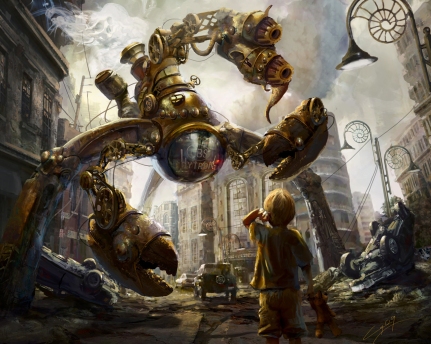 Steampunk is defined as “a genre of science fiction that has a historical setting and typically features steam-powered machinery rather than advanced technology.” To me, it’s more than modern technology with a Victorian twist. This genre has been on the rise with its push in video games with the award winning Bioshock franchise, TV series like Steampunkd, and in books, starting with the Godfather of Steampunk, Jules Verne, to authors like Cherie Priest and Michael Moorcock.
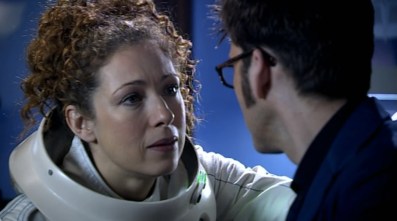 #5. Silence in the Library/Forest of the Dead (May 2008) – These episodes made my list because it introduced us to River Song, played by the wonderful Alex Kingston. Here’s a character that knows the Doctor and his many faces. I was hanging on her every word trying to find some clue as to who the Doctor really is, but “spoilers!” She has been one of my favorite characters/companions of the series. This episode makes you sad at how many people died needlessly, but it also gave me a sigh of relief as they were all “saved” by CAL (you have to watch the episode to understand that reference). Let’s not forget that this was a great story, in itself, especially for an author like me. An entire planet is the world’s biggest library. I love to think that my books are sitting on a shelf there, stored for all eternity. The best part, though, is the end when David Tenant figured out the reason why, his future self, gave River a sonic screwdriver and then to watch him run “one last time” together. Plus, to see that come full circle and played out in last year’s Christmas episode with Peter Capaldi just brought the entire story to a wonderful finish.
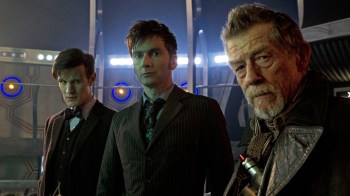 #4. The Day of the Doctor (November 2013) – This special commemorated the 50th anniversary of Doctor Who. It not only introduced us to John Hurt as the War Doctor, but it also gave us the best online video tie-in (“Night of the Doctor” with Paul McGann, who finally got his regeneration) and the best on-screen surprise guest. First off, I loved the late John Hurt as the War Doctor. He gave us the solemn attitude and vulnerability of the Doctor on the day when “he couldn’t be the Doctor.” In that one episode, John Hurt endeared himself to me, and to all of us Whovians I think. We all knew David Tenant and Matt Smith were going to be in the special, and they brilliantly shot one-liners back and forth off each other, as expected. The surprise was in the final battle, where they were assisted by all 13 Doctors, including our first look at the “angry eyebrows” in Peter Capaldi. Lastly, the end of the episode where Matt Smith met up with the curator, aka Tom Baker, the 4th Doctor (MY DOCTOR). It was a shock and surprise that I still enjoy watching, over-and-over again. His brilliant performance showed that once you play the Doctor, you never stop being the Doctor.
 #3. The Girl Who Waited (September 2011) – This is one of my favorite episodes because it gave us to the woman who is Amy Pond. We got to see all her vulnerabilities, all the pain and tragedy she has experienced as a companion. Amy gets trapped on a planet that has been quarantined due to a deadly disease that affects people with two hearts (like the Doctor). On top of that, those infected by the plague are placed in one of several thousand accelerated time streams, allowing them to live out their lives. This means the Doctor and Rory are out of sync with Amy and they try to rescue her after she spends more than 36 years there, alone. All this time alone made her rethink her relationship with the Doctor and not to trust him. The entire episode is an emotional roller coaster and, as a fan, it touched on the deep and meaningful relationship the Doctor has with each of his companions and how it both hurts and helps them. It reminded me of a quote from another great episode, Love & Monsters, where Elton goes on about “salvation and damnation” and if you touch or are touched, by the Doctor, it could destroy you. It was heartbreaking at the end when older Amy had to be left behind, in a sense justifying her concerns and fears about the Doctor; but then again, it’s these hard decisions that he must make, as a Timelord, that weighs heavy on his hearts.
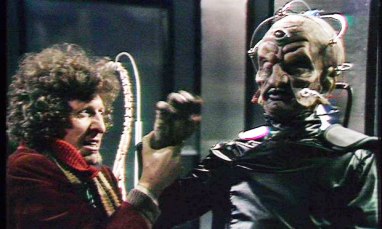 #2. The Genesis of the Daleks (March/April 1975) – Although the Daleks were introduced in the first season of Doctor Who, this episode gave us an in depth look at their creation and introduced us to their creator, the villainous Davros. First and foremost, Tom Baker is “my Doctor” and this where we saw the Doctor at his best. He is sent to Skarro by the Timelords to interfere in the creation of the Daleks and hopefully prevent the future death and destruction they wreak across the universe. In this episode, we learn why the Daleks were created without compassion or pity, turning them into ruthless war machines. In one of his best scenes as the Doctor, Tom Baker holds two wires in his hands, connecting them would detonate explosives and wipe out the Dalek’s incubation room. He holds those wires and asks “Have I the right?” to commit genocide of an entire race. That scene makes the entire six episode run one of the best in the history of Doctor Who. The impact these episodes had on the series reverberates in the future, from Sylvester McCoy’s Doctor (Remembrance of the Daleks, October 1988), Christopher Eccleston’s 9th Doctor (The Parting of Ways, June 2005), David Tenant’s 10th Doctor (Stolen Earth/A Journey’s End, June/July 2008), Matt Smith’s 11th Doctor (Asylum of the Daleks, September 2012), and finally, with Peter Capaldi’s 12th Doctor (The Magician’s Apprentice/The Witch’s Familiar, September 2015). That’s what makes this episode one of the most important episodes in the history of Doctor Who.
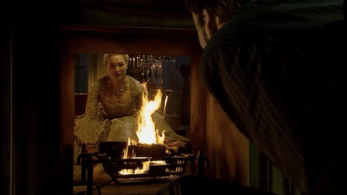 #1. The Girl in the Fireplace (May 2006) – I know that my number one pick resonates with many Whovians. It was one of the most critically acclaimed episodes of Doctor Who, nominated for a Nebula Award and winning a Hugo Award for Best Dramatic Presentation. This episode made you laugh, made you cry, and sometimes, scared you to death. A ship in the far distant future opens a hole in time and space to France in the 1700s to keep an eye on a little girl and wait until she grows up into a woman. Why? To cannibalize her for parts for the ship. Weird as it sounds, it’s fun to watch the Doctor go through time with Madam de Pompadour. Like “The Girl Who Waited” this episode jumps through time as the Doctor tries to protect her from the clockwork soldiers who are after her. It has one of the most touching scenes as the two look at the stars in completely different light. It also has some of the funniest scenes with a horse, a banana daiquiri, and “snogging” Madam de Pompadour. There are also some of the best lines ever in Doctor Who like, “One may tolerate a world of demons for the sake of an angel;” “There is a vessel in your world where the days of my life are pressed together like the chapters of a book so that he may step from one to the other without increase of age, while I, weary traveler, must always take the slower path;” and “This is my lover, the King of France … Yeah, well I’m the Lord of Time.” It’s such a beautiful episode that will go down as one of, if not the best, in the history of Doctor Who.
 It’s hard to believe that we are on our third Spider-man movie franchise, third Superman movie franchise and sixth movie-version of Batman. Technically, if you want to count television in these ongoing franchises, that’s six Superman, four Spiderman, four Wonder Woman (I have to count the failed Adrianne Palicki TV show because they shot a pilot), three Captain America, four Hulks, three Fantastic Four, three Flash and two Daredevil’s and Doctor Strange. The X-Men did it right by inter-mingling all of its movies together in one universe.
 There are many TV shows, movies and books that are considered the “standard” by which all others are compared. There are many that try to lay claim to that title in the realm of science fiction, fantasy and adventure genre. Lord of the Rings, Star Trek and Star Wars are among the top contenders for those top spots. To me, none can compare to what I consider “the standard” and that is Doctor Who.





 Mark Piggott | Fantasy & Steampunk Author