 Today is Memorial Day, a day when we honor the sacrifice of military service members who died in defense of our great nation. According to Wikipedia, the holiday originated as Decoration Day after the American Civil War in 1868, when the Grand Army of the Republic, an organization of Union veterans founded in Decatur, Illinois, established it as a time for the nation to decorate the graves of the war dead with flowers. By the 20th century, competing Union and Confederate holiday traditions were celebrated on different days until they merged together and Memorial Day was extended to honor all Americans who died while in the military service.
This day holds special meaning to me as a retired U.S. Navy Chief Petty Officer, but also because of the service of other members of my family. My family has served in the armed forces dating back to the Revolutionary War. My 5th Great Grandfather, Phillip Bailey, served in the Virginia Militia. Then there’s my 3rd Great Grandfather, John P. Bailey, who served in the Confederate Army in the 22nd Virginia Infantry, 1st Kanawha Regiment, under the command of George S. Patton, the grandfather of World War II General George S. Patton. My grandfather, William E. Davis, was a Parachute Rigger on the USS Bataan (CVL 29) during World War II. My father, MSGT William R. Piggott, USMC (Ret.) did two tours in Vietnam during his 22-year career. I can also include my mother, two uncles, a cousin, my brother, sister-in-law and a nephew who served in the Navy and Marine Corps. We are a military family.
Most of the people of our great nation strive to honor the heroes who paid the ultimate sacrifice for our freedom, but there are some who seem to resent the military. They burn or step on the flag as a form of protest to our government, forgetting the fact that it was our veterans who put their lives on the line to ensure they have the freedom to do that. People want to tear down war memorials because the represent the racial strife of the past, ignoring the men and women who died on both sides of war.
One of my favorite quotes is, “Those who cannot remember the past are condemned to repeat it.” Those words were spoken by George Santayana, a philosopher, essayist, poet, and novelist. It’s not surprising that writers are the ones who not only record such historical events, we also provide analysis, observations, and insight. As writers, we are the caretakers of our heroes, villains, and the history they create through their actions.
Our veterans sacrificed so much, in war, in peace and in defense of freedom around the world. They deserve our respect and our undying gratitude for the sacrifices they’ve made. Just to put it in perspective, since 2001, there have been 2,229 deaths and 20,904 casualties in Afghanistan and 4,488 deaths and 36,710 casualties in Iraq. This year marks the 50th anniversary of the Vietnam War, a conflict that cost us more than 58,209 deaths and 211,454 casualties. These numbers just keep rising the further we go back in our history.
So please, as you’re barbecuing or enjoying the sun and fun this Memorial Day, please take a moment to remember our veterans whose sacrifice gave us our freedoms in the U.S.A.
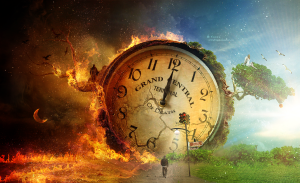 Death is always an option for writers, especially since death is a natural part of life. Heaven and Hell are concepts we’ve learned about from Christianity, Judaism and Islam. Although, there are many who are skeptical of religion and do not believe in an afterlife. For example, reincarnation is a concept of the afterlife found among Hindus, Buddhists, Jains, Sikhs, Rosicrucians, Theosophists, Spiritists, and Wiccans. Before that, you have varied concepts of the afterlife from the Fields of Elysium and Tartarus to Valhalla and Limbo.
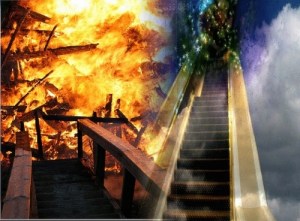 It was Plato who said, “The soul takes nothing with her to the next world but her education and her culture. At the beginning of the journey to the next world, one’s education and culture can either provide the greatest assistance or else act as the greatest burden, to the person who has just died.” Although this sounds a little more like reincarnation than the afterlife, I think it speaks of a higher purpose. We are taking all we are from this world into the next when we die. That’s a lot of baggage to bring with you. The stories of one’s life can be told by what you take with you into the next. That brings some peace and solace while others hope it is enough to earn them a place in the afterlife.
 Forever Avalon is available for purchase at
  Inspiration … it’s a word I use a lot in most of my social media posts. You’ll find #inspiration in almost everything I write. I can relate to so many different things as I weave my stories together. Movies, books, television, theater, and music give me the focus and drive in everything I do. Even as I am writing this blog, I am listening to Joss Whedon’s 2005 sci-fi classic Serenity.
 It’s the simplest things in life that inspire us. I remember a few months ago when I was working to finish the third book in the

 Let’s start at the end and work our way back. In 1973, Heston starred in Soylent Green with Chuck Conners, Leigh Taylor-Young, and the great Edward G. Robinson. In the year 2022, the people of Earth survive on a ration known as Soylent Green. When an executive at the factory is murdered, Detective Robert Thorn (Heston) investigates the case. This leads to conspiracy, intrigue, and murder along with the shocking discovery that their rations are made from the dead. Like a lot of the other movies of its time, Soylent Green hit upon the fear of the era … overpopulation, starvation, nuclear war, etc. The film is loosely based upon the 1966 science fiction novel Make Room! Make Room! by Harry Harrison. It won the Nebula Award for Best Dramatic Presentation and the Saturn Award for Best Science Fiction Film in 1973. This was also Edward G. Robinson’s last movie so that makes it even better, but it’s Heston that drives this film. His performance turned, what could have been a boring movie, into an edge of your seat crime thriller.
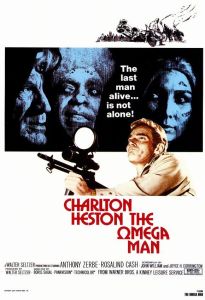 In 1971, Charlton Heston starred in The Omega Man, based on the novel I am Legend by Richard Matheson. If that sounds familiar to you, it is the same name as the 2007 movie I am Legend starring Will Smith. There was also a 1964 adaptation called The Last Man on Earth starring Vincent Price. In any case, Heston’s version is, to me, the true representation of the novel. It’s about Dr. Robert Neville (Heston) the sole survivor of a plague that killed or turned most of the population into zombie-like creatures. His blood held the key to curing the victims and also vaccinating other survivors. This movie had many firsts, including the first interracial kiss between Heston and co-star Rosalind Cash as Lisa. Another great aspect of the film was the empty streets of Los Angeles. They filmed in downtown LA on a Sunday morning to show the post-apocalyptic, deserted streets. Though the movie only got a 55% rating on
 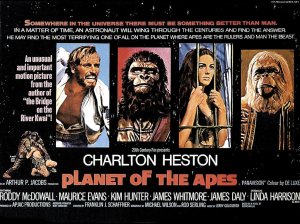 The last movie is the 1968 classic Planet of the Apes and it’s sequel, Beneath the Planet of the Apes. As astronaut George Taylor, Heston and his team’s space flight takes them more than 2000 years into the future where apes now rule and humans are mute slaves. Of course, you don’t find this out until the end of the movie when you see the classic image of the Statue of Liberty, rusted and torn apart on the shoreline. This movie hits on a big theme of that era, equality and racism, but this time, it’s the humans being discriminated against. The movie was the first for large-scale make-up effects for all the actors cast as apes. Heston shines in his role as the only talking human in a world of talking apes. His arrogance, vanity, and narcissism comes through in his tough-guy persona as he struggles to survive. He also has to share time with the late great Roddy McDowell, who starred in all five Planet of the Apes movies. In the end, though, this is one of Heston’s most memorable roles.
 Mark Piggott | Fantasy & Steampunk Author