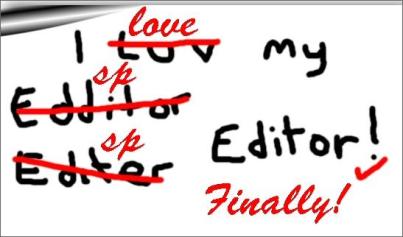
 It’s the worst thing for a high school or college student, and worst for a journalist or author … The dreaded red pen marks. Those notes and edits—whether on a term paper, thesis or manuscript—can send a writer into a tizzy. You wonder if it means your ideas suck, your writing is terrible or prose just God awful. Sometimes that’s true, but most times, it’s far from the truth. As writers, we are far from perfect. We miss the occasional comma, overuse a word or phrase, and forget the “y” on “they” turning it into “the” so spellcheck doesn’t catch it. That’s why every writer needs a good editor to help catch the things we miss.
I’m currently editing my third novel in the Forever Avalon series, The Outlander War, and it’s the first time I’m working with an editor. I just glanced at Page 1 (he’s editing by hand to start) and it’s covered in red. I panicked, but soon realized that it’s a lot of structure issues, not the story itself, and my mind was put at ease.
Seeing red can bring back bad memories. For me, it was shortly after I published my first novel, Forever Avalon. I received free copies of my novel from my publisher and sent them out to family and friends. Within the first month, I received an email from my mother with two pages of spelling and grammatical errors she found in the book. Nothing is more humbling for a writer than to have your mother correct your work.
In the end, I pulled the book, made the edits and got it back out, but all of that could have been avoided with a little editing help. There are professional book editors out there for self-published authors with varying prices in relation to word count. If money’s an issue, then turn to a friend or colleague to take a read on your manuscript.
Seeing red is not a bad thing because, in the end, it provides your readers with a clean, crisp story that flows better without the occasional drop off due to a missing comma or misspelled word. Remember, spellcheck is not your friend. It can easily miss a lot of mistakes. Plus, a human eye can look for those little subtleties in continuity.
For example, as a fantasy writer, if your wizard casts a spell and it does one thing on page 25, and something completely different on page 79, that’s something you need to catch. It’s a lot for a writer to keep up with, which is why you need to pair up with a good editor to make your manuscript smooth as silk.
So don’t fear the red pen. If you establish a good working relationship with your editor, then their edits will help, not hurt, your manuscript. In the end, it’s still your story, but now it’s a well edited story that’s an easy read.
***
 Mark Piggott is the author of the Forever Avalon book series. Forever Avalon is available for purchase at Amazon and Barnes and Noble. The Dark Tides is available for purchase at Amazon, Barnes and Noble, and iUniverse. The Outlander War can be previewed at Inkitt.
![avalon_by_iribel[166]](https://authormarkpiggott.com/wp-content/uploads/2017/03/avalon_by_iribel166.jpg?w=390&h=523) Why Avalon? Why indeed … I’ve been asked this question many times. Why did I choose Avalon, Camelot, Merlin, King Arthur and the whole Arthurian legend as the basis for my novels in the
Why Avalon? Why indeed … I’ve been asked this question many times. Why did I choose Avalon, Camelot, Merlin, King Arthur and the whole Arthurian legend as the basis for my novels in the 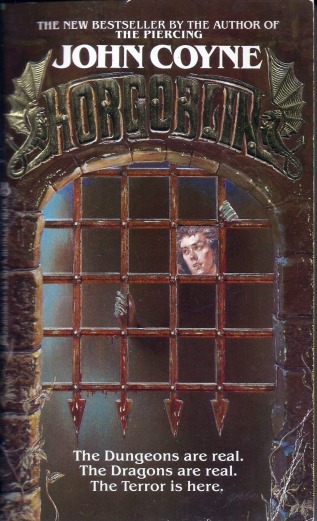 The story revolves around Scott Gardiner, a teenage boy who becomes obsessed with “Hobgoblin,” a fantasy role-playing game based on Irish mythology, as his life “in the game” and “in reality” slowly blend. Like Mazes & Monsters, Coyne treats the playing of role-playing games as indicative of deep neurotic needs, of which I can attest to from my formative years of non-stop D&D. In these books, the protagonist is, or at least appears to be, suffering from schizophrenia or some analogous condition as the attainment of mature adulthood is accompanied by the abandonment of role-playing games. Like Jaffe, Hobgoblin was published at the height of D&D‘s popularity and the intense media coverage of the “Egbert steam tunnel” incident (i.e., urban myths wherein role-playing gamers enacting live action role-playing games perish, often in the utility tunnels below their university campuses).
 My journey as a writer has been a long and tumultuous one. It’s something I never really considered for myself as a teenager, or even through my 20+ year Navy career. I wanted to talk to you about my journey to hopefully explain how being a writer can come right out of left field, until you realize that it was meant to be.
 Mark Piggott | Fantasy & Steampunk Author