
“All things truly wicked start from an innocence.”─ ERNEST HEMINGWAY, A Moveable Feast
I don’t get it … Villains are becoming more popular than heroes nowadays. People cheer and rave over characters like Venom, Hannibal Lecter, Darth Vader and Dracula. What happened to the days of good guys who wore white and bad guys wore black. You could clearly identify who the bad guys were and you never felt an ounce of sympathy for them.
Today, there writing books, TV series and movies centered around villains. For example, Fox’s TV series Lucifer. I mean, its a show about the devil on Earth. Here’s the guy, whom I was taught in endless Sunday School lessons, was the epitome of evil and he’s portrayed as if he cares about humanity. How can a guy be the ultimate evil if he’s a softy for solving crimes? It doesn’t make any sense.
Comic book characters like Venom, Deadpool and Harley Quinn are being pursued as quasi-heroes, characterized as bad, yet somewhere, deep down inside, therein lies a hero. Even Disney villains are not what they’re cracked up to be. Maleficent was, by all counts, and evil sorceress. That’s how she was portrayed in the Sleeping Beauty movie I saw as a kid. And yet, with the help of Angelina Jolie, she’s became a complicated villain and Aurora’s father is the true villain of this movie. Wait, what?
“Many evil things there are that your strong walls and bright swords do not stay.” ─ J. R. R. TOLKIEN, The Fellowship of the Ring
You see how confusing it has become. There are more movies, books and TV shows out there with villains who are loved, not scorned. I mean, vampires and demons used to be some of the scariest monsters out there. I remember the Exorcist, The Omen, and all the old Hammer horror films featuring Christopher Lee’s Dracula. Even the original Salem’s Lot TV movie (starring David Soul of Starsky & Hutch fame) was as terrifying as the Stephen King novel. Every time I heard something at my window, I wondered if there was a child vampire floating outside, asking to invite me in.
I believe there is good and evil, no in between. To me, you can’t justify the immorality and wanton disrespect for life. A killer is a killer, plain and simple. Can you really justify someone like Charles Manson or John Wayne Gacey? The monsters are not redeemable nor should they be.
In the article “So bad it’s good: Why do we find evil so alluring?”, writer Terry Eagleton had a simple answer. “One answer might be: when goodness began to look boring. We can blame this on the puritanical middle classes. It is they who redefined virtue as thrift, prudence, meekness, abstinence, chastity and industriousness. It’s not hard to see why some people should prefer zombies and vampires. Goodness came to seem negative and restrictive.”
As a writer, I take evil quite seriously. To me, evil is just that, evil. Writers have the responsibility to show people what evil looks like. I we can help them recognize what true evil is, you can avoid it, and even destroy it.
Here is an excerpt from my upcoming third novel in the Forever Avalon series, The Outlander War, where the two villains of my story–Abdel Ben Faust and a “yet to be named” master–meet and discuss their plot to destroy the Gil-Gamesh and take the throne of Avalon.
###
On Avalon, South Essex was known as a city of artisans. The finest craftsman could be found in South Essex of all mediums—wood, metalwork or canvas—as well as exceptional tailors, tinkers, and tradesmen. It was a town full of the finest shops you could ever find outside of New Camelot.
The Black Swan was one of the most reputable taverns in South Essex, with the finest wine and spirits in all of New Camelot. The food at the Black Swan also had a reputation for being the best served in all Avalon. But even the best places can attract some unsavory characters.
Inside, the tavern was brightly lit with the glow of candlelight and roaring fires. The rooms were decorated in the finest silk drapes and tapestries of red and black. The décor epitomized the name of the tavern as swans could be seen represented in various shapes and sizes from statues to wall sconces.
While the rest of the tavern was crowded, as usual, the back of the room was empty, except for one guest. The owner did this at the request of the guest but also so his other patrons wouldn’t be subjected to his company.
He sat alone with his back to the wall, gorging himself on rare roasted beef and bottles of 500-year-old Aldinian Whiskey. He appreciated spirits, especially rare ones, and he always came to the Black Swan whenever he was in town because they always carried the best.
His name was Abdel Ben Faust, a mercenary by trade and considered by many as the finest swordsman on Avalon. His long black hair was pulled back tightly in a ponytail, exposing his pointed ears and long face. A scar ran from his left temple, across his nose, and down his right cheek … A reminder of being cut from his mother’s womb. His mustache was long and thin, hanging down below his chin, but that was where his true heritage showed through.
His skin was reddish-brown and, from his chin, grew horns that resembled a goatee, twisted like braided hair. Abdel Ben Faust was a half-demon, the son of a witch and an Incubus, conceived during a blood moon in a magical ritual. His mother died while giving birth to him. He had to be cut from her womb by the same clerics that killed his demon father.
Faust was raised a slave, tormented regularly for his demonic form, but in his torment grew strength and resolve. He molded himself from slave to warrior, becoming a master swordsman, available to the highest bidder.
He has avoided conflict with the Gil-Gamesh since his return to Avalon thanks to an innate ability from his demonic lineage. Faust can conjure “demon holes” to move from place-to-place, unseen. Demon holes were doorways of black smoke, fire, and brimstone. Only binding him in iron chains prevented him from using his power.
Faust came to South Essex to indulge his tastes while the Gil-Gamesh and the rest of the Knights of the Round Table moved to the coast to protect Avalon from the Outlanders. He knew there would be no trouble coming to the Black Swan and drinking his fill before moving on to his next job.
The curtain to the back room was pulled aside as young Finnick Devereaux, son of the Earl of South Essex, Sir Robert Devereaux, stepped in. The young man was nearly 50, young for a noble of Avalon. His dirty blonde hair, dashing good looks and fine clothes endeared his upright lineage. He pulled a handkerchief from his inside pocket and waved it in front of his face as he tried to dispel the stench coming from Faust.
“He is here milord, just as I said,” Finnick said to someone behind the curtain. A robed, hooded figure stepped through, walking right past the young noble.
“Good … Leave us Finnick, and make sure we are not disturbed,” the hooded figure said.
“Are you sure you want to do this milord?” Finnick asked. “The last man who interrupted Abdel Ben Faust while he was eating had his head chopped off and tossed into a stew pot.”
“Not worry, I’ve come bearing gifts,” he said as pulled a bottle from out of robe pocket. Finnick just bowed and left the room, closing the drapes behind him.
The stranger walked up to Abdel’s table but stopped when he drew his sword as he chugged down the last of the whiskey, resting his blade across the table. It was a broad sword, nearly four feet long, with a jagged edge etched along the top edge of the blade. Wisps of smoke rose up from the sword, as if it was burning, as the runes etched on the blade glowed softly. This was Deathsong, a cursed blade that only Abdel Ben Faust could wield and he did so very well.
“I’d think twice before sitting down,” Faust warned as he finished his drink. The stranger just placed the bottle down in front of him. Faust dropped his own bottle to examine the gift.
“Can it be?” he exclaimed. “Panaque, distilled from the vines of the dryads of Meliai, over 4,000 years old!” He popped the cork and smelled the delicate bouquet of the fine spirit. He looked up at the stranger and nodded his head to the chair in front of him. The hooded figure sat down as Faust sheathed his sword and poured himself a drink.
“So to what do I owe this honor and who do I have to kill to keep this bottle?” he asked as he took a sip of the delicious liquid.
“The bottle is yours, Abdel Ben Faust, a gift for listening to what I have to say,” he began. “But first, I have a question for you. Last year, when Morgana le Fay was resurrected, why were you not part of her forces at the Battle of Idlehorn Mountain? Surely a swordsman of your caliber could have turned the tide in her favor.”
Faust seemed to be insulted by the stranger’s accusation but took it in stride for the moment. “Her cause was lost from the moment she began,” he scoffed as he took another sip.
The hooded man seemed irritated by his answer but just sat back and listened. “Why do you say that?”
“Because she let the Gil-Gamesh live,” he answered. “You don’t give someone like the Gil-Gamesh any glimmer of hope. She should have killed him when she had the chance. That’s always been the problem with despots like Kraven Darkholm and Morgana le Fay. They want that power but they want to gloat about it in the process. That’s what got them killed.
“I don’t side with losing causes,” he concluded as he downed the last of his drink. “I’ve answered your question, now you answer mine … What do you want?”
“I want you to lead an army to take Avalon out of the grips of the Pendragon’s and the Gil-Gamesh,” the stranger said without skipping a beat.
Faust just laughed under his breath. “Well if you wait long enough, the damn Outlanders with all their technological weapons will do it for you.”
“Oh, I doubt that,” the stranger impugned. “If the Gil-Gamesh is as resourceful as you say, then all I have to do is wait until he restores Avalon as it was before, hidden from the outside world. Then, we tear Avalon apart, taking the throne and killing him in the process.”
Faust was not convinced by the hooded stranger’s plan. He laughed again as he poured himself another drink. “Well in the first place, you’d need an army at least 10,000 strong,” Faust calculated. “Hell, the goblins don’t even have half that number anymore, and the trolls are all whipped lackeys for that Shield Maiden now. So where is this army you speak of?”
The stranger reached into his robe and pulled out the ruby amulet, still glowing from the strong magic’s imbued within. Faust just looked at the amulet, unfazed and uncaring. “What’s that supposed to be?” he asked.
“The key to controlling the most powerful army in creation, the Wraith Legion of Purgatory!” Abdel Ben Faust was stunned, aghast at the stranger’s claim. The Wraith Legion was an army of fallen knights, trapped in purgatory because of some dishonor or shame that fell upon them in life. They served a penance, keeping the demons of the underworld in check until, one day, they’ve earned their place in Heaven.
“No one can control the Wraith Legion. It’s impossible,” he exclaimed.
“You can with this,” the stranger said, dangling the amulet. “With this amulet, they will follow your every command. You will be their General, Abdel Ben Faust, and you will conquer Avalon for me.
“In return, I will give you the Twin Swords of the Dragon Moon as payment, for your collection.”
It is known that Abdel Ben Faust has, over time, collected the sword or weapon of every knight, every warrior and every monster he ever bested in battle. He kept his collection hidden from prying eyes. He liked to savor each and every victory by looking at the weapons of his fallen enemies hanging on the walls of his vault. Adding the swords of the Gil-Gamesh would be the centerpiece of his collection.
The stranger had intrigued Faust with his offerings but wasn’t convinced completely just yet. He needed to know something more. “Who are you?” he asked.
The hooded figure stood up and peeled back his hood, revealing his face to Faust. The half-demon was stunned as he recognized the face almost immediately. “You? But that’s impossible, you’ve been dead for centuries, millennia even! It can’t be you!”
The stranger pulled the hood back over his head and sat back down. “I assure you, it is me, Abdel Ben Faust. I have many machinations at work, but I need a general to lead my army. You are the one man I can entrust with this task because I know that you will only accept my offer if you believe it can succeed.
“So will you, will you join me?” he asked. Faust sat there, stroking his chin, contemplating all the stranger has offered him. After a few moments, he raised his glass to him.
“When do we get started?”
###
 Mark Piggott is the author of the Forever Avalon book series. Forever Avalon is available for purchase at Amazon and Barnes and Noble. The Dark Tides is available for purchase at Amazon, Barnes and Noble, and iUniverse. The Outlander War can be previewed at Inkitt.


 I think Wonder Woman is one of the most inspiring characters in comics today. Since her creation in World War II, she has fought for the same values as Superman (Truth, Justice, and the American Way) while at the same time confronting the unreal stereotypes of women outside the home. Though she has been portrayed on TV by many great actresses, it took her more than 75 years to finally end up on the silver screen. In my opinion, they had to wait until Gal Gadot and director Patty Jenkins came along.
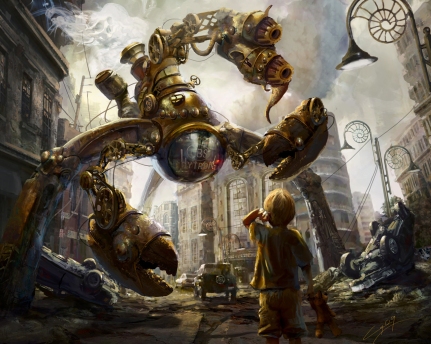 Steampunk is defined as “a genre of science fiction that has a historical setting and typically features steam-powered machinery rather than advanced technology.” To me, it’s more than modern technology with a Victorian twist. This genre has been on the rise with its push in video games with the award winning Bioshock franchise, TV series like Steampunkd, and in books, starting with the Godfather of Steampunk, Jules Verne, to authors like Cherie Priest and Michael Moorcock.
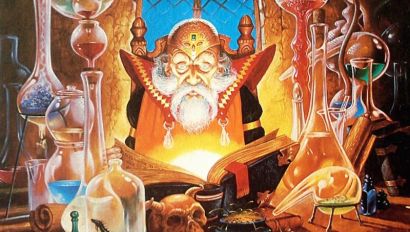 It’s good to be bad, am I right? There seems to be a trend where anyone touched by or practicing magic is always seduced to darkness. The same goes for those who gain incredible powers or become something more than human. It begs the age-old question, “power corrupts and absolute power corrupts absolutely.”
 Recently, Marvel’s Vice President of Sales, David Gabriel, claimed that the company’s recent focus on creating diverse superheroes is a driving factor behind its declining comic book sales. He said, “Any character that was diverse, any character that was new, our female characters, anything that was not a core Marvel character, people were turning their nose up.”
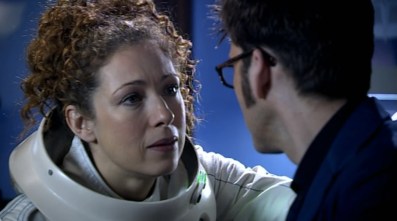 #5. Silence in the Library/Forest of the Dead (May 2008) – These episodes made my list because it introduced us to River Song, played by the wonderful Alex Kingston. Here’s a character that knows the Doctor and his many faces. I was hanging on her every word trying to find some clue as to who the Doctor really is, but “spoilers!” She has been one of my favorite characters/companions of the series. This episode makes you sad at how many people died needlessly, but it also gave me a sigh of relief as they were all “saved” by CAL (you have to watch the episode to understand that reference). Let’s not forget that this was a great story, in itself, especially for an author like me. An entire planet is the world’s biggest library. I love to think that my books are sitting on a shelf there, stored for all eternity. The best part, though, is the end when David Tenant figured out the reason why, his future self, gave River a sonic screwdriver and then to watch him run “one last time” together. Plus, to see that come full circle and played out in last year’s Christmas episode with Peter Capaldi just brought the entire story to a wonderful finish.
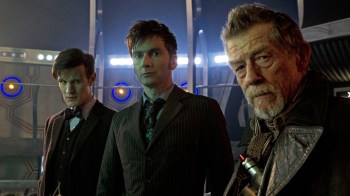 #4. The Day of the Doctor (November 2013) – This special commemorated the 50th anniversary of Doctor Who. It not only introduced us to John Hurt as the War Doctor, but it also gave us the best online video tie-in (“Night of the Doctor” with Paul McGann, who finally got his regeneration) and the best on-screen surprise guest. First off, I loved the late John Hurt as the War Doctor. He gave us the solemn attitude and vulnerability of the Doctor on the day when “he couldn’t be the Doctor.” In that one episode, John Hurt endeared himself to me, and to all of us Whovians I think. We all knew David Tenant and Matt Smith were going to be in the special, and they brilliantly shot one-liners back and forth off each other, as expected. The surprise was in the final battle, where they were assisted by all 13 Doctors, including our first look at the “angry eyebrows” in Peter Capaldi. Lastly, the end of the episode where Matt Smith met up with the curator, aka Tom Baker, the 4th Doctor (MY DOCTOR). It was a shock and surprise that I still enjoy watching, over-and-over again. His brilliant performance showed that once you play the Doctor, you never stop being the Doctor.
 #3. The Girl Who Waited (September 2011) – This is one of my favorite episodes because it gave us to the woman who is Amy Pond. We got to see all her vulnerabilities, all the pain and tragedy she has experienced as a companion. Amy gets trapped on a planet that has been quarantined due to a deadly disease that affects people with two hearts (like the Doctor). On top of that, those infected by the plague are placed in one of several thousand accelerated time streams, allowing them to live out their lives. This means the Doctor and Rory are out of sync with Amy and they try to rescue her after she spends more than 36 years there, alone. All this time alone made her rethink her relationship with the Doctor and not to trust him. The entire episode is an emotional roller coaster and, as a fan, it touched on the deep and meaningful relationship the Doctor has with each of his companions and how it both hurts and helps them. It reminded me of a quote from another great episode, Love & Monsters, where Elton goes on about “salvation and damnation” and if you touch or are touched, by the Doctor, it could destroy you. It was heartbreaking at the end when older Amy had to be left behind, in a sense justifying her concerns and fears about the Doctor; but then again, it’s these hard decisions that he must make, as a Timelord, that weighs heavy on his hearts.
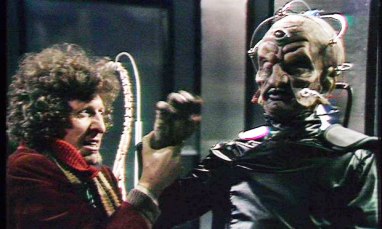 #2. The Genesis of the Daleks (March/April 1975) – Although the Daleks were introduced in the first season of Doctor Who, this episode gave us an in depth look at their creation and introduced us to their creator, the villainous Davros. First and foremost, Tom Baker is “my Doctor” and this where we saw the Doctor at his best. He is sent to Skarro by the Timelords to interfere in the creation of the Daleks and hopefully prevent the future death and destruction they wreak across the universe. In this episode, we learn why the Daleks were created without compassion or pity, turning them into ruthless war machines. In one of his best scenes as the Doctor, Tom Baker holds two wires in his hands, connecting them would detonate explosives and wipe out the Dalek’s incubation room. He holds those wires and asks “Have I the right?” to commit genocide of an entire race. That scene makes the entire six episode run one of the best in the history of Doctor Who. The impact these episodes had on the series reverberates in the future, from Sylvester McCoy’s Doctor (Remembrance of the Daleks, October 1988), Christopher Eccleston’s 9th Doctor (The Parting of Ways, June 2005), David Tenant’s 10th Doctor (Stolen Earth/A Journey’s End, June/July 2008), Matt Smith’s 11th Doctor (Asylum of the Daleks, September 2012), and finally, with Peter Capaldi’s 12th Doctor (The Magician’s Apprentice/The Witch’s Familiar, September 2015). That’s what makes this episode one of the most important episodes in the history of Doctor Who.
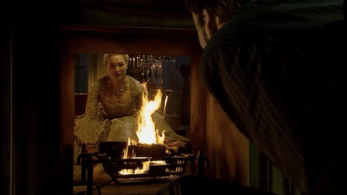 #1. The Girl in the Fireplace (May 2006) – I know that my number one pick resonates with many Whovians. It was one of the most critically acclaimed episodes of Doctor Who, nominated for a Nebula Award and winning a Hugo Award for Best Dramatic Presentation. This episode made you laugh, made you cry, and sometimes, scared you to death. A ship in the far distant future opens a hole in time and space to France in the 1700s to keep an eye on a little girl and wait until she grows up into a woman. Why? To cannibalize her for parts for the ship. Weird as it sounds, it’s fun to watch the Doctor go through time with Madam de Pompadour. Like “The Girl Who Waited” this episode jumps through time as the Doctor tries to protect her from the clockwork soldiers who are after her. It has one of the most touching scenes as the two look at the stars in completely different light. It also has some of the funniest scenes with a horse, a banana daiquiri, and “snogging” Madam de Pompadour. There are also some of the best lines ever in Doctor Who like, “One may tolerate a world of demons for the sake of an angel;” “There is a vessel in your world where the days of my life are pressed together like the chapters of a book so that he may step from one to the other without increase of age, while I, weary traveler, must always take the slower path;” and “This is my lover, the King of France … Yeah, well I’m the Lord of Time.” It’s such a beautiful episode that will go down as one of, if not the best, in the history of Doctor Who.
 It’s hard to believe that we are on our third Spider-man movie franchise, third Superman movie franchise and sixth movie-version of Batman. Technically, if you want to count television in these ongoing franchises, that’s six Superman, four Spiderman, four Wonder Woman (I have to count the failed Adrianne Palicki TV show because they shot a pilot), three Captain America, four Hulks, three Fantastic Four, three Flash and two Daredevil’s and Doctor Strange. The X-Men did it right by inter-mingling all of its movies together in one universe.
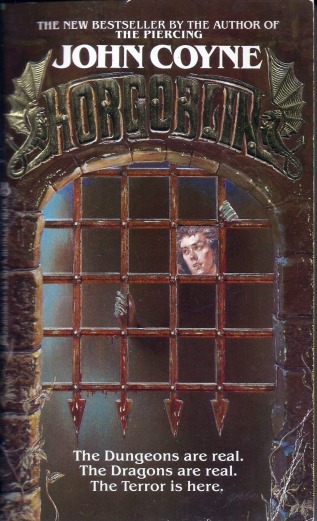 The story revolves around Scott Gardiner, a teenage boy who becomes obsessed with “Hobgoblin,” a fantasy role-playing game based on Irish mythology, as his life “in the game” and “in reality” slowly blend. Like Mazes & Monsters, Coyne treats the playing of role-playing games as indicative of deep neurotic needs, of which I can attest to from my formative years of non-stop D&D. In these books, the protagonist is, or at least appears to be, suffering from schizophrenia or some analogous condition as the attainment of mature adulthood is accompanied by the abandonment of role-playing games. Like Jaffe, Hobgoblin was published at the height of D&D‘s popularity and the intense media coverage of the “Egbert steam tunnel” incident (i.e., urban myths wherein role-playing gamers enacting live action role-playing games perish, often in the utility tunnels below their university campuses).
 Most people remember their favorite movies through unforgettable scenes or great quotes. There are many, though, that you remember from a few notes of music or humming a tune. Add to that, there are so many memorable songs and music from movies, you don’t know where to start.
 Next is great movie musicals. I’m partial to West Side Story and The Sound of Music because I grew up on these movies. However, my all-time favorite has to be The Rocky Horror Picture Show. I was a teenager going out every Friday and Saturday night to dance the Time Warp, ask “Whatever Happened to Saturday Night” and wonder if we’re having Meatloaf fir dinner. The music is intoxicating and holds your heart and soul captive like a trans-sexual transvestite from Transylvania.
 Mark Piggott | Fantasy & Steampunk Author