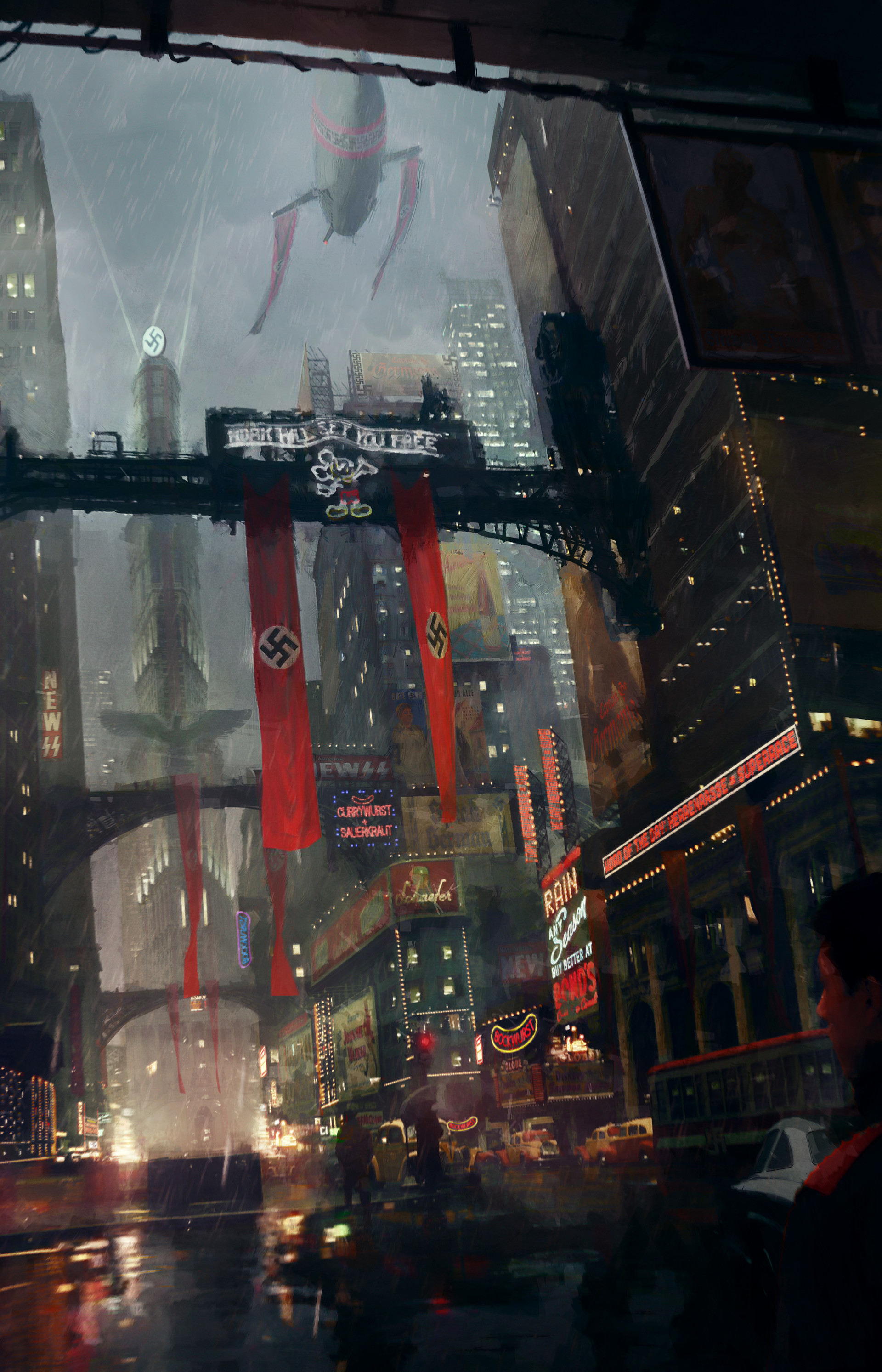
Historical fiction takes you on another path, sometimes good and sometimes bad

Image result for man in the high castle fan art
“The Man in the High Castle” fan art by Luis Guggenberger

I am currently in the midst of a major writing project that is different from anything I have written before. Historical fiction is not an easy genre to write. There are plenty of stories out there, like Harry Turtledove “How Few Remain” or Philip K. Dick “The Man on the High Castle” for example. These stories takes the world and turn it on end beyond what we know as history. It’s just science fiction but rather, as the term is coined, a historical fiction. These stories take one moment in history and with a simple turn of the switch, the world as we know it changed.

For example, in “How Few Remain” there was a moment in the Civil War where General Robert E. Lee sent out battle plans to his generals. One courier wrapped those plans around some cigars, but lost them enroute. These battle plans were found by a Union soldier and that gave them the edge over the Confederate general. This single moment in time changed the course of the war, in the eyes of the writer. That’s what it takes to create a good historical fiction… One moment in time changed and that brings about a new timeline. Doctor Who refers to this as a “fixed moment” in time, one that cannot change, like Rosa Parks refusing to get out of her seat on the bus in Montgomery, Alabama, in 1955. By changing these moments in time, we can change the future. To that end, a writer of historical fiction must be a writer and a historian.

Granted, you don’t have to be a history major to write historical fiction, but you need to research the Hell out of it. My current #WIP is Corsair and the Sky Pirates. The story is based on one of those pivotal moments in history, a chance meeting between Nikola Tesla and Jules Verne. This is where my story begins, but I first had to research a simple question… Were Jules Verne and Nikola Tesla ever in France at the same time? That question was essential to my story, and the answer was yes. In 1887, Tesla was working for the Continental Edison Company in Paris, France. At that time, Jules Verne lived in Amiens, France, just north of Paris. There existed the possibility of that chance meeting, so as a writer of fantasy and science fiction, I made it happen.

From that meeting grew a story of a new world, a new industrial revolution started years earlier than expected. This would be a steampunk world where fragments of a meteor would power technology, built by Tesla from the imagination of Verne. Oh, what a wonderful world it would be, right? That is how a historical fiction begins.

Many books of this fashion focus on two distinct moments… The Civil War or World War II. Seeing a different outcomes to these monumental, worldwide clashes piques the curiosity of readers. We all look at the world and wonder what difference would be made at these pivotal moments, a world under Nazi rule or where slavery extended beyond the Civil War. These are evil times, easy to prophesize and lay out because evil has one goal… Power!

Image result for tesla and edison
Thomas Edison vs. Nikola Tesla

So, in my own historical fiction, I had that moment in history but I needed a villain. That was easy for me. As Tesla was my protagonist, the only choice for an antagonist was Thomas Edison. Now, don’t get me wrong, I don’t think Edison was an evil man. He was a genius, an inventor of the precursor of much of the technology we use today. But, he was also a capitalist, interested in making money. Like many corporations today, i.e. Apple, Google, Twitter and the likes, controlling the narrative means controlling the people in the world. That’s the villain I needed, corporations. When you move the industrial revolution forward, you’re automatically giving control over to the corporations that provide us with technology that makes our life easier, for a price. I wanted to represent our current addition to technology and bring it to bear in a steampunk, industrialized world. Edison was the perfect villain for my story.

That’s the beauty of writing historical fiction. You can change the world into something completely different. From turning Abraham Lincoln into a Marxist/Socialist (“How Few Remain”) to an alliance between Roosevelt, Churchill and Hitler to fight back an alien invasion (“Worldwar” series), it is an open book when writing historical fiction. The key is to base it in history. Where you go from there depends on the storyteller.

Research is the best thing for anyone writing historical fiction. I’ve learned more about the world at the turn of the century since I started writing this story. I learned about Jack Johnson, Geronimo, William Hearst, and more. From the people, to the countries, to the events, it is an open book… Better yet, an open world for any writer to explore. It’s the ability to create a world from one we all know, but make it new and make it different.

# # #

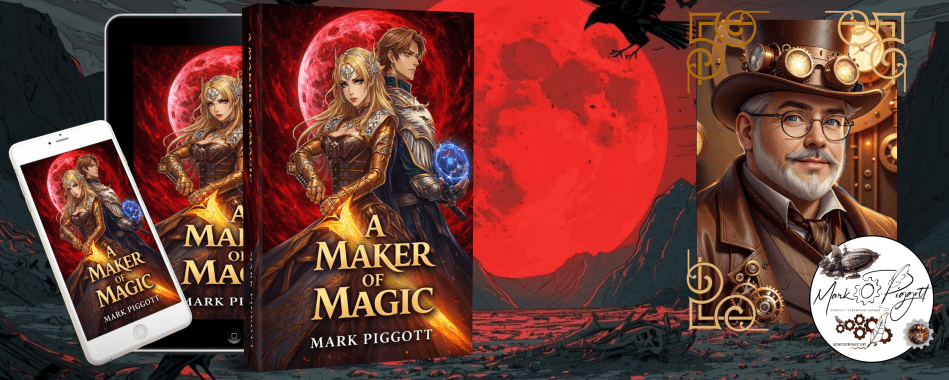
Mark Piggott is the author of the Forever Avalon fantasy book series. Forever Avalon is available for purchase as a paperback/ebook at Amazon. The Dark Tides: Book 2 of the Forever Avalon Series is available for purchase as a paperback/ebook from iUniverse Publishing and at Amazon, and other booksellers. The Outlander War, Book Three of the Forever Avalon series is available for purchase as a paperback/ebook from Austin Macauley Publishing, and at Amazon and other booksellers.

The nightmare that is research all writers must face

Researching elements for your next novel can be as time consuming as writing it. Depending on the subject matter–whether its fantasy, science fiction, supernatural, or historical–any author worth their pen and paper want their stories to make sense. Accuracy is the key to all this research. But even then, you sometimes have to make concessions for the sake of storytelling.
You can take one subject and find hundreds of different interpretations of the same mythology or history. Take the Arthurian legend of which the Forever Avalon series is based. Did you know that more than 70 authors have used King Arthur as the basis for a novel? There are six adaptations in musical theater of the King Arthur mythos, and more than 20 plays of classic verse. (Yes, I am including Spamalot! in my numbers!) Additionally, there have been 11 operas, 42 feature films on the characters (plus 22 more considered parodies) and five television series. This is not even counting the numerous episodes from Doctor Who to Japanese anime that feature characters from the Arthurian legend. Safe to say, there is plenty of material to research this one topic.

So, for the sake of argument, lets talk about research in general. In today’s day-and-age, Google is your best friend. I have used that search engine for everything from names (first and surnames), language translation, cities and countries names, historical references, etc. It is a one stop shop for everything a writer needs. I even found a reference sheet of “Other words for said” depending on the emotion of the moment. You can’t beat it from spending countless hours in a library, fighting over reference materials. I’m not saying there’s anything wrong with spending hours in a library. Those are some of my fondest memories. But this allows you to do the research in your pajamas, something most libraries frown upon.

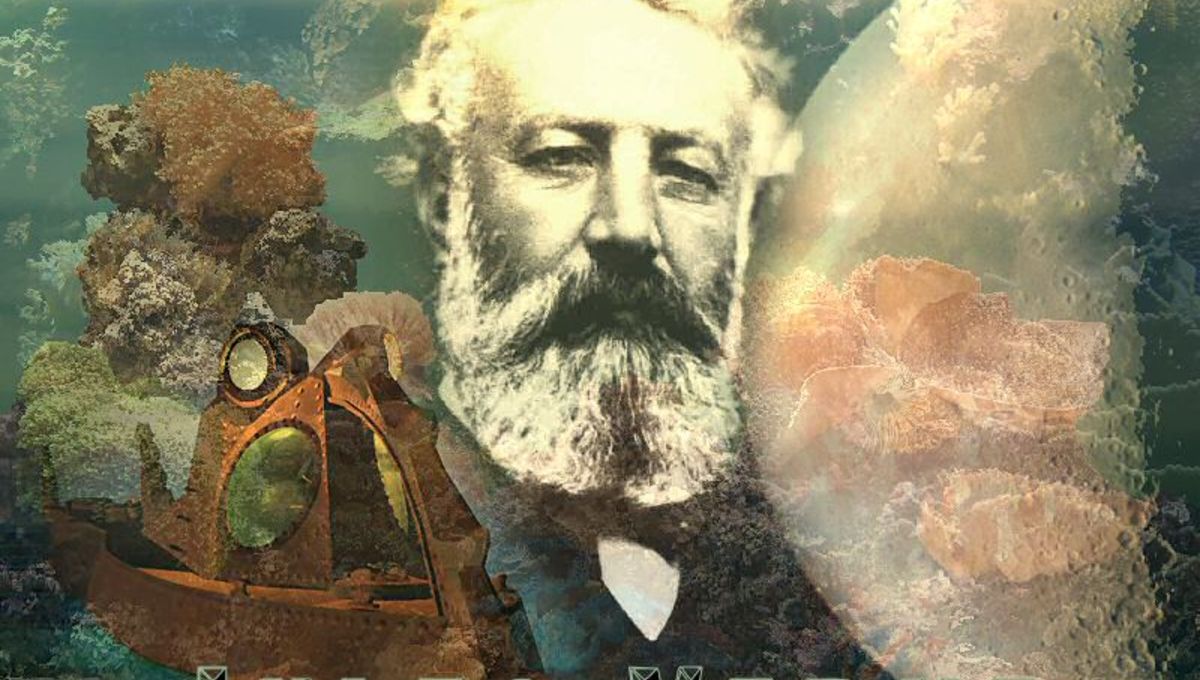
Happy Birthday, Jules Verne: 70 years of fantastic comic-book classicsThere is a broad basis for research, but to me, some of the best research is in the stories I read. Other writers give me inspiration, tips on writing styles, and ideas behind the story itself. For example, I love alternate history novels. Harry Turtledove is one of my favorite writers of alternative history. That gave me pause when I started working on my own alternate history, a world where Nikola Tesla and Jules Verne met and created a “steampunk” future with Tesla’s inventions and Verne’s inspiration. To do that, I had to research their life story to see if they were every in proximity to meet. Fun fact:  They were! Tesla worked for the Edison Company in France while Verne lived there. That gave me the track to create my story.

This is the importance of research. Even for a fantasy or science fiction story, you need to base what you do in fact. There are times that the story can actually inspire the real thing. Did you know that Steve Jobs got the idea for digital music and the iPod after watching an episode of Star Trek: The Next Generation? Gene Roddenberry inspired one of the greatest inventions of our time, not to mention cell phones, iPads, etc. That’s the power of the writer.

The moral to the story is to do your research with all the vigor and vitality you put into writing your story. Even with otherworldly elements within most fantasy/sci-fi stories, they are based on our own history. For Forever Avalon, I researched every know mythology known to mankind. Did you know that Dwarves are featured in the mythologies from Norse to Germanic, Anglo-Saxon to Russian. There are more myths on creation than you can shake a stick at. You have to read through all of this information and cut it down to fit what you’re writing about.

The biggest thing you can do is have a plan. I started my own writing “on the fly” based on my the story that was rattling around in my head, but that doesn’t always work. My subsequent novels have been more planned out, outline oriented. I still start writing the ideas down “on the fly” but I found that I needed to write things down more as I go along, outline it, make a list of everything from character names, city and country names, even languages used as a basis for magic spells. All of this makes it easier to build the world I am creating within my story.

I hope I’ve given you some good tools and examples of what to do and what not to do when researching subjects for your novel. I think astronaut Neil Armstrong said it best … “Research is creating new knowledge.” However, I like this quote even beter:

“Research is what I’m doing when I don’t know what I’m doing.” — Wernher von Braun

# # #

SKU-000941753

Mark Piggott is the author of the Forever Avalon book series. Forever Avalon is available for purchase as a paperback/ebook at Amazon. The Dark Tides is available for purchase as a paperback/ebook at AmazonBarnes and Noble, and iUniverse Publishing. The Outlander War, Book Three of the Forever Avalon series is available from Austin Macauley Publishing.

Building a world, from the ground up, isn’t as easy as you think

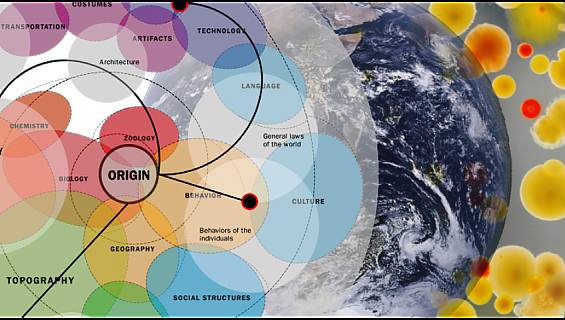
Worldbuilding: How to Create a Believable World for Your Fiction ...

Worldbuilding is defined as “the process of creating a fictional world that can be as complex as designing an entirely new and unique location with exotic creatures, societies, religions, and governments.”

Most people think creating the story is the first step of a writer. Wrong. The first step is creating the world. Sure, the story is the idea, but you can’t have a story with the world it exists in. Whether that be another world like Middle Earth or a dystopian future, version of the United States, you need to create it first so you know the elements you’ll need in your story. We’re talking people and races, type of government, land masses, bodies of water, etc. Your cities will need names, what religion do they worship (if any), even the technology used (medieval, steampunk, cyber-tech, etc.) all need to be considered.

In the Forever Avalon series, I had to create the island of Avalon, from the various races, land masses, creatures, etc. It was a daunting task. I started with the capital, New Camelot, and worked out from there. A lot of my world building included a lot of research on myths and legends. From the Elven city of Alfheimer to the Dwarf mountain of Hursag, these are places within the our world mythology when it comes to Elves and Dwarfs. Since Avalon became a repository for all magic in the world (in my story), I wanted it to accurately portray the legends while adding my own touch.

When writing, you set your characters out on quests and journeys, and to do so, you need to know where they’re going and what lands or obstacles are in their way. Forests, mountain ranges, towns and cities all need to be identified with unique names and their own personality, for lack of a better word. In Avalon, the Fenris Mountains were named because the jagged peaks resembled the teeth of the legendary creature. Blackbriar Forest so named because, in the deep recesses of the woods, no light can pierce the canopy, leaving it a dark and dangerous place to travel. Merlin’s Pinnacle is a lone peak that stands separate from any mountain range, said to be the resting place of the eternal magician. These are just some of the places I created within the world of Forever Avalon, and even now, I’m adding or changing things as the story progresses.

One of the best tools in world building, for me, was Dungeons and Dragons. I played the RPG religiously as a young adult. As a writer, I found it to be a great tool in world building and character development. In fact, I took some of the characters and places I used as a Dungeon Master and player in D&D and used them in my novels. For example, in my latest novel, The Outlander War, there  is a new character named Abdel Ben Faust, a half-demon mercenary. This character is based on a half-orc fighter I played in the game. I had to make some adjustments since Orcs don’t exist in my world, but the basis for the character came from D&D.

A Brief Intro To Worldbuilding – Alexandra Peel

I also took inspiration from other fantasy novels, which I’m sure many authors do. In the Forever Avalon series, the home of my protagonist, Lord Bryan MoonDrake, is the floating dragon island of Emmyr. I took this from my love of Michael Moorcock and the Elric series, in which Melniboné (The Dragon Isle) and only surviving city is Imrryr, known as The Dreaming City. For many of us today, it’s the authors of these series that has inspired us to write our own stories. As they say, imitation is the most since form of flattery.

Another great tool for world building, especially when it comes to names, is Google. Searching through the different names in different cultures, whether its a Surname list or using Google translate to look up words in different languages for a town name, it becomes a helpful tool for writers. For example, when I named taverns and inns in Avalon, I always named them after an animal with an adjective to make it more colorful:  The Grinning Toad, The Weathered Wren, The Green Griffon, The Crooked Goose. This kept my thought process in line as I was writing the stories.

Maps are also useful. I’m no mapmaker, but as I put things together in my novel, I made a makeshift map of the world I was creating. I just marked the major points so I could figure out directions and to ensure consistency as I wrote my novel. I didn’t want to say they went north one time, and the next time they were going to the same place but I said south instead. You need to be consistent in your planning.

So, you need to think long and hard about the world you’re creating. The landscape is as essential as character development.

# # #

SKU-000941753

Mark Piggott is the author of the Forever Avalon book series. Forever Avalon is available for purchase as a paperback/ebook at Amazon. The Dark Tides is available for purchase as a paperback/ebook at AmazonBarnes and Noble, and iUniverse Publishing. The Outlander War, Book Three of the Forever Avalon series is available from Austin Macauley Publishing.

The great search for what to write about, better known as “Research Hell”

The-writer2-e1374715549958As both an instructor at the Defense Information School (DINFOS Trained Killer!) and a guest speaker to high school students about writing, I always stress one thing above all … RESEARCH! Youcan’t write the next “Great American Novel” unless you do your research and to that I say, thank God for Google!

I don’t know how I survived high school, college and military “A” school without the internet. I can remember looking things up in gigantic volumes of Encyclopedia Britannica, both at home and at the local library, whenever I had a paper due. Even though they were outdated after a few years, you had to reference them in practically everything you wrote about.

After the internet and home computer came online, the best source for research was Microsoft Encarta. I remember buying it for my home computer so my kids had an available reference tool without having to go online. In the days of 56 kbs, the internet was slow moving and tedious, especially when all we had was dial-up.

Research is the key for any writer, and not just about your subject matter. For both Forever Avalon and The Dark Tides, I based a lot of my story on my own imagination and characters I played during my informative years of Dungeons and Dragons. That’s when I discovered I had a lot of holes in my story that I needed to fill.

So I began researching mythologies of every culture from Norway to Germany and Britain to Africa. I learned how to curse in Viking and used a latin translator program (thank you University of Notre Dame) as the basis for spells. I can’t even begin to imagine how long I would have had to spend in my local library, looking through book after book, tearing through the card catalogue to find every last bit of research I needed.

That’s why I said “thank God for Google!” As much as many of us hate the “Big Brother” aspect of the internet giant, they are an invaluable tool for the writer. Add to that dictionary.com, because you always need to find different ways to say words in a story to avoid repitition.

Most of all, remmeber where every story begins … in the heart and soul of the writer. As I’ve said before, the Forever Avalon series came from recurring dreams after long hours of D&D while deployed thousands of miles from my family. It was in that emotional void that I found the story I was waiting my whole life to tell.