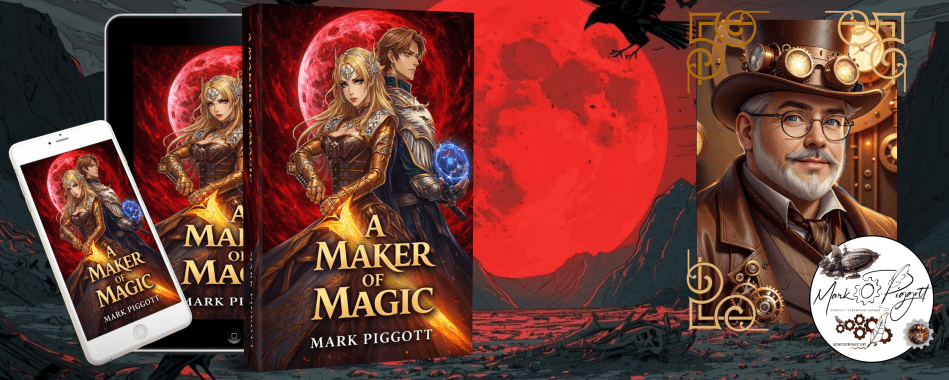
 We’ve all experienced it, some more than most. It is an obsession that we can’t explain nor can we understand ourselves. With me, it began in college in the 1980s, where I was introduced to Dungeons and Dragons. That’s where I fell for it hook, line, and sinker.
Hello, my name is Mark and I’m addicted to fantasy!
It was automatic for me. I created my first D&D character and started my adventure into role playing. From that point on, I was obsessed with it and could think of or do nothing else. I played every weekend, from Friday night straight through to Monday morning. I even became a Dungeonmaster and ran my own game. I even went as far as to join a local group with the Society of Creative Anachronism.
I went to see every sci-fi/fantasy film that came out in the 80s, from Dragonslayer to Krull, Conan the Barbarian to The Beastmaster. On television, I watched Xena or Hercules, even The Dungeons and Dragons Saturday morning cartoon. It was like a drug and I couldn’t get enough. I started reading anything and everything, from Michael Moorcock’s Elric saga to J.R.R. Tolkien, Terry Brooks’ Shannara Chronicles and C.S Lewis The Lion, the Witch and the Wardrobe.
 Even after I joined the Navy, I continued to play D&D. I found friends aboard the ship and we played during our duty days and off-duty hours. When I eventually stopped playing, I turned my obsession around and started writing, and it was from that, I created my Forever Avalon series. I was able to tap into my fertile imagination, fueled from all those years of role playing games, movies, television and inspiring stories from other authors. It was a magical journey that I’m still riding on, even today.
Josie Glausiusz wrote in Scientific American, “Daydreams are an inner world where we can rehearse the future and imagine new adventures without risk. Allowing the mind to roam freely can aid creativity—but only if we pay attention to the content of our daydreams.” She also said that “When daydreaming turns addictive and compulsive, it can overwhelm normal functioning, impeding relationships, and work.” I can honestly attest to that determination.
When I played D&D, I ignored a lot of things to play the game. It was a deep-rooted obsession that drove me out of college, without a job or education and into my military career in the Navy. In that sense, it did me a big favor. My career in the Navy made me the writer I am today.
You have to tame your obsession, even more, today. With the internet, video games and better CGI effects in movies, there is a resurgence in the fantasy genre that gives us more to do and see. From Warcraft to Lord of the Rings, fantasy has taken center stage again. We have the chance to see our dreams in full color, high-definition, and 3D.
Glausiusz said, “Yet to enhance creativity, it is important to pay attention to daydreams.” That’s where we, as authors, filmmakers, and even musicians find our muse and translate fantasy into words, images, and sounds. That is, at the heart of it all, why we love fantasy. It is a means to escape from reality and bring everyone else along for the ride. It’s why I don’t mind living with my obsession.
***
 Forever Avalon is available for purchase at Amazon and Barnes and Noble. The Dark Tides is available for purchase at Amazon, Barnes and Noble and iUniverse. The Outlander War can be previewed at Inkitt.
 Writer’s Block is defined as “the condition of being unable to think of what to write or how to proceed with writing.” For many writers like me, we just call it “a slow march into Hell with only a thimble of water to drink.” It can make or break any author. It will make you miss deadlines, collapse goals and potentially lose money we haven’t earned from our last book. In other words, a bottomless pit from which there is no escape for the weak and weary. Once you’re there, it’s hard to climb your way out of it.
 The BFG, written by Roald Dahl in 1982 and directed and produced by Steven Spielberg, is the only book by Dahl that hasn’t been made into a feature film previously. The BFG (Mark Rylance), while a giant himself, is a Big Friendly Giant and nothing like the other inhabitants of Giant Country. Standing 24-feet tall with enormous ears and a keen sense of smell, he is endearingly dim-witted and keeps to himself for the most part. Giants like Bloodbottler (Bill Hader) and Fleshlumpeater (Jemaine Clement) on the other hand, are twice as big and at least twice as scary and have been known to eat humans, while the BFG prefers Snozzcumber and Frobscottle. Upon her arrival in Giant Country, Sophie, a precocious 10-year-old girl from London, is initially frightened of the mysterious giant who has brought her to his cave, but soon comes to realize that the BFG is actually quite gentle and charming, and, having never met a giant before, has many questions. The BFG brings Sophie to Dream Country where he collects dreams and sends them to children, teaching her all about the magic and mystery of dreams.
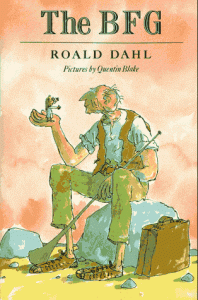 This brings me back to my opening statement. Kids, and even parents, today flock to Finding Dory instead of The BFG. Don’t get me wrong, I love the Pixar movies, but to see a classic like The BFG ignored for a talking fish is sad. This generation is so hung up on movies, television, the internet, and video games that they all but ignore reading such great stories. It’s only because of technology today that movies can bring these stories to life. Watching The BFG made me want to read the book again, to bring back the magic from long ago.
 I just wanted to let everyone know I will not be blogging for the next two weeks, but I have a very good reason. I will be supporting the 2016 Wounded Warrior games at the West Point Military Academy. I will be writing stories about the games, covering all the major events and ceremonies as well as publishing some feature articles on the athletes themselves.
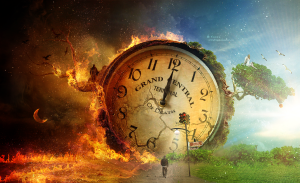 Death is always an option for writers, especially since death is a natural part of life. Heaven and Hell are concepts we’ve learned about from Christianity, Judaism and Islam. Although, there are many who are skeptical of religion and do not believe in an afterlife. For example, reincarnation is a concept of the afterlife found among Hindus, Buddhists, Jains, Sikhs, Rosicrucians, Theosophists, Spiritists, and Wiccans. Before that, you have varied concepts of the afterlife from the Fields of Elysium and Tartarus to Valhalla and Limbo.
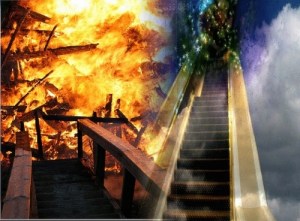 It was Plato who said, “The soul takes nothing with her to the next world but her education and her culture. At the beginning of the journey to the next world, one’s education and culture can either provide the greatest assistance or else act as the greatest burden, to the person who has just died.” Although this sounds a little more like reincarnation than the afterlife, I think it speaks of a higher purpose. We are taking all we are from this world into the next when we die. That’s a lot of baggage to bring with you. The stories of one’s life can be told by what you take with you into the next. That brings some peace and solace while others hope it is enough to earn them a place in the afterlife.
 Inspiration … it’s a word I use a lot in most of my social media posts. You’ll find #inspiration in almost everything I write. I can relate to so many different things as I weave my stories together. Movies, books, television, theater, and music give me the focus and drive in everything I do. Even as I am writing this blog, I am listening to Joss Whedon’s 2005 sci-fi classic Serenity.
 It’s the simplest things in life that inspire us. I remember a few months ago when I was working to finish the third book in the
 Let’s start at the end and work our way back. In 1973, Heston starred in Soylent Green with Chuck Conners, Leigh Taylor-Young, and the great Edward G. Robinson. In the year 2022, the people of Earth survive on a ration known as Soylent Green. When an executive at the factory is murdered, Detective Robert Thorn (Heston) investigates the case. This leads to conspiracy, intrigue, and murder along with the shocking discovery that their rations are made from the dead. Like a lot of the other movies of its time, Soylent Green hit upon the fear of the era … overpopulation, starvation, nuclear war, etc. The film is loosely based upon the 1966 science fiction novel Make Room! Make Room! by Harry Harrison. It won the Nebula Award for Best Dramatic Presentation and the Saturn Award for Best Science Fiction Film in 1973. This was also Edward G. Robinson’s last movie so that makes it even better, but it’s Heston that drives this film. His performance turned, what could have been a boring movie, into an edge of your seat crime thriller.
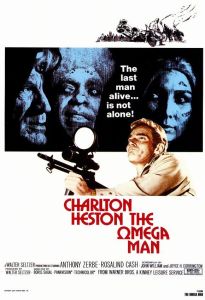 In 1971, Charlton Heston starred in The Omega Man, based on the novel I am Legend by Richard Matheson. If that sounds familiar to you, it is the same name as the 2007 movie I am Legend starring Will Smith. There was also a 1964 adaptation called The Last Man on Earth starring Vincent Price. In any case, Heston’s version is, to me, the true representation of the novel. It’s about Dr. Robert Neville (Heston) the sole survivor of a plague that killed or turned most of the population into zombie-like creatures. His blood held the key to curing the victims and also vaccinating other survivors. This movie had many firsts, including the first interracial kiss between Heston and co-star Rosalind Cash as Lisa. Another great aspect of the film was the empty streets of Los Angeles. They filmed in downtown LA on a Sunday morning to show the post-apocalyptic, deserted streets. Though the movie only got a 55% rating on
 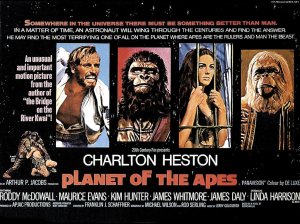 The last movie is the 1968 classic Planet of the Apes and it’s sequel, Beneath the Planet of the Apes. As astronaut George Taylor, Heston and his team’s space flight takes them more than 2000 years into the future where apes now rule and humans are mute slaves. Of course, you don’t find this out until the end of the movie when you see the classic image of the Statue of Liberty, rusted and torn apart on the shoreline. This movie hits on a big theme of that era, equality and racism, but this time, it’s the humans being discriminated against. The movie was the first for large-scale make-up effects for all the actors cast as apes. Heston shines in his role as the only talking human in a world of talking apes. His arrogance, vanity, and narcissism comes through in his tough-guy persona as he struggles to survive. He also has to share time with the late great Roddy McDowell, who starred in all five Planet of the Apes movies. In the end, though, this is one of Heston’s most memorable roles.
 “Life is to be lived, not controlled; and humanity is won by continuing to play in the face of certain defeat.” That’s from Invisible Man by Ralph Ellison. That’s just one constant you can always find throughout literature, words to live by and wisdom to navigate through the rivers of self-doubt. As authors, we represent the struggles of not only our own lives but that of the world events happening around us. Authors want to instill hope, courage, determination and justice in the words we right.
 Mark Piggott | Fantasy & Steampunk Author