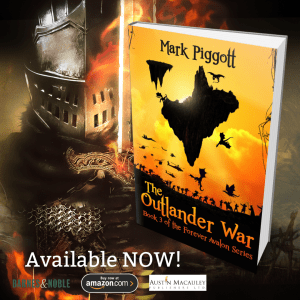
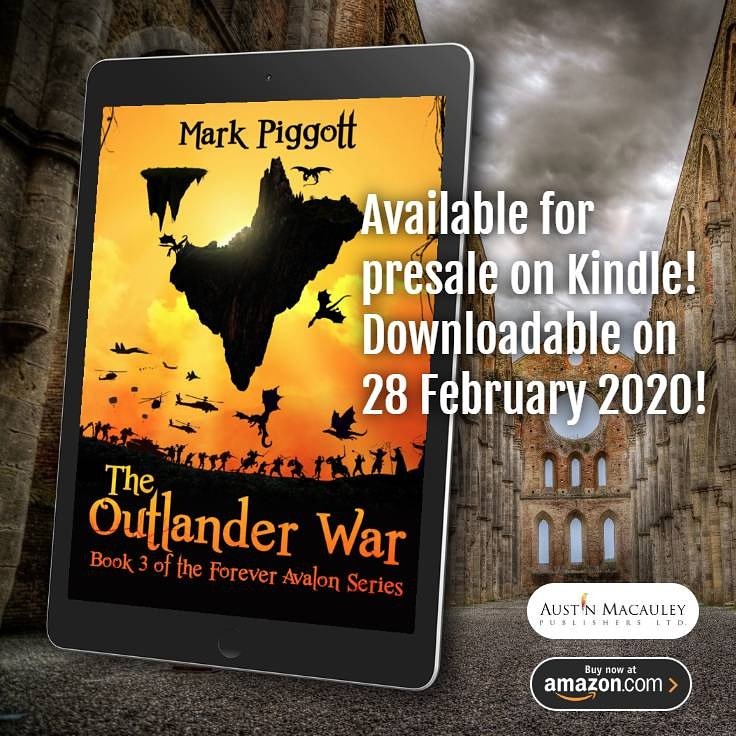
I have two great bits of news to report this week on The Outlander War: Book 3 of the Forever Avalon Series! This has been one of the best weeks I’ve had as an author and I wanted to share it with you.
The Outlander War completes my first trilogy, the third book in the Forever Avalon series. In the middle of the Atlantic Ocean, in the heart of a naval exercise, Avalon suddenly reappeared, causing disruptions on both fronts. The US Navy, now circling the mysterious island, wants answers. The tensions build as modern technology faces off against ancient magic on an island where the laws of magic supersede the laws of science, causing mechanical weapons to falter and shut down. As military forces continue to surround the mysterious island, bringing both sides to the brink of war, an ancient evil arises from within, one that has been seeking the throne of New Camelot for three millennia.

First up, I did an interview with a wonderful author and podcaster, Segilola Salami of The Segilola Salami Show. Her virtual cafe is always open with tips and advice for authors, book readers and other literary enthusiasts. We talked about the ins and outs of self-publishing, the problems facing an independent author, and my fantasy novels and the myths and legends behind them. It was a great interview, from one side of “the pond” to the other, and I would recommend you checking it out as well as listening her other podcasts! You won’t be disappointed.
 Secondly, The Outlander War made the short list (lucky #7) for the 2019 Drunken Druid Book Award from the Emerald Isle of Ireland. The Drunken Druid aims to exhibit, nurture and promote creative people in accordance with the highest professional standards. In 2013, an Awards Program for the best original full-length novel was created to bring recognition to books of up and coming authors. This literary prize is awarded each year for the best original full-length fictional novel. This is a tremendous honor for me and I can’t thank Sara Knight and the entire Drunken Druid staff for considering me for this award.
So, after being stuck indoors for nearly six weeks with just my wife and my dog during a pandemic, worrying about my own future as an author, I’ve had my best week ever. Here’s to hoping that better things yet to come!
# # #


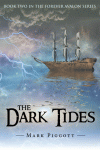
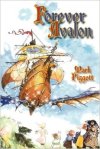
 Mark Piggott is the author of the Forever Avalon book series. Forever Avalon is available for purchase as a paperback/ebook at Amazon. The Dark Tides is available for purchase as a paperback/ebook at Amazon, Barnes and Noble, and iUniverse Publishing. The Outlander War, Book Three of the Forever Avalon series is available from Austin Macauley Publishing.





 Another great example is Star Wars. Now, there have been hits and misses with the franchise since the end of Return of the Jedi. The animated series have been top notch, the Rogue One prequel was OUT OF BOUNDS! However, they have not found the original magic from these successes in later projects. The Force Awakens was good, The Last Jedi not so much. Solo was, in my opinion, better than I expected it to be, but it had too many plot holes. I am looking forward to the Mandalorian Netflix series as well as future releases after Episode 9 (which I am patiently holding my breath for) because they will be original movies separate from the Skywalker saga. That’s where they need to go. We don’t need a reboot of the same characters with new actors, but rather, let’s go to another part of the vast universe.
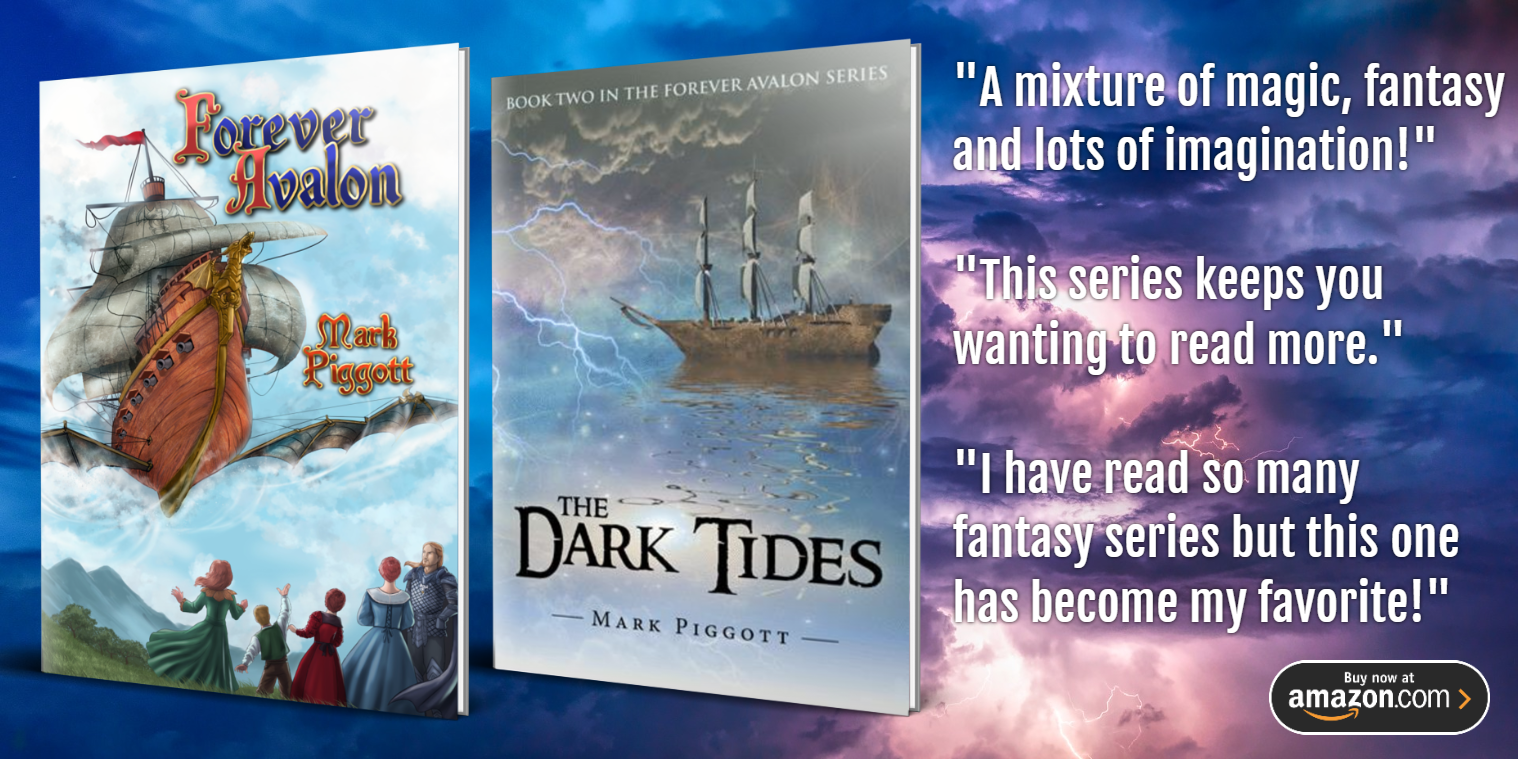
 “Stephanie Drake and her three children were glad to be alive after a sudden storm slammed their boat onto an uncharted island, but it’s not where they think. They found themselves in another world, frozen in time. For more than 3,000 years, the magical island of Avalon remained hidden from the outside world. It was a place of eternal magic, where the descendants of King Arthur ruled over a land filled with magical creatures, wizards, Elves, Dwarves and dragons. On Avalon, Stephanie and her children were being hunted by bounty hunters, thieves and brigands. They found themselves caught in a power struggle between Lord Kraven Darkholm, a powerful wizard descended from the sorceress Morgana le Fay, and Lord Bryan MoonDrake, the Gil-Gamesh of Avalon. The people of this magical isle have been protected for centuries by the Gil-Gamesh, a descendant of Sir Percival Peredyr, the last Knight of the Round Table. But who is Lord MoonDrake and how does he know so much about Stephanie and her children? Now, it’s a race against time as the Gil-Gamesh must protect these Outlanders—as they are called—and get them home to the outside world. All the while, Kraven Darkholm continued his schemes against the people of Avalon, vying to achieve his ultimate goal of becoming ruler of this enchanted island.”
 It’s taken me over a year, but I’ve finally finished writing and editing the third book in the Forever Avalon series, The Outlander War. This is the finale of the first trilogy in the series following
  There are many walls that writers have to hurdle to make it to the finish line as a published author. Sometimes those walls are self-imposed, like writer’s block, and other times those walls are caused by outside forces, like a publisher’s rejection letter. All of these walls can be overcome and soon, you’re on your way to being a published author.
 Hope…It’s a word associated with many things, like Star Wars, President Obama, and the first game of your favorite sports team’s season. Hope is a part of faith, family, and charity. This past week, watching the aftermath of Hurricane Harvey filled me with hope for humanity as I watched people helping others without thought of their own safety.
