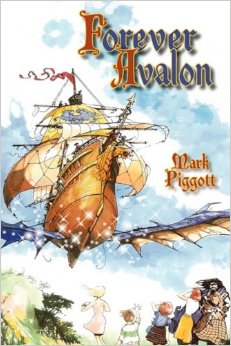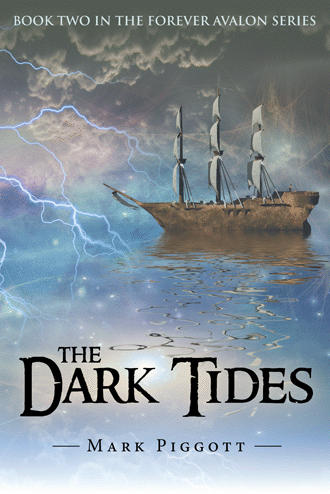
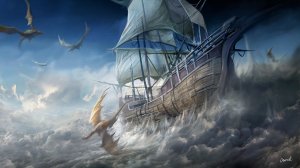
The Outlander War: Book Three of the Forever Avalon series
The concept behind my third book in the Forever Avalon series, The Outlander War, is magic and technology crossing paths. I really wanted to explore what would happen if magic somehow returned to the real world. A part of that too is the age-old question of which is more powerful of the two … Technology or magic.
I began to dabble into this in a “steampunk” sort of way in my second book, The Dark Tides, with the creation of GunStars and Lancers, weapons that fired magical/alchemical munitions called “spellshots” from their barrels. However, in The Outlander War, we get modern warfare versus medieval might as the Gil-Gamesh and the forces of Avalon brace for a possible attack by the United States Navy.
Here is an excerpt that demonstrates what happens when machines and magic collide, literally.
***
Soaring the skies around Emmyr was what Rose loved to do best. When she was up there, flying on the back her dragon, Dee Dee, she was in Heaven. Dee Dee was her best friend, ever since she rescued her in the cave-in when Dee Dee was just a baby dragon. Since then, they formed a bond stronger than any magic in all of Avalon.
Rose could fly to the ends of the Earth on Dee Dee and that still wouldn’t be far enough. The only exception was when she was flying with Edan, her one true love. That was when she had the two things she loved in most life all at once.
Unfortunately, she was flying around Emmyr with her brother, Hunter, and he was never fun to be with. In her estimation, Hunter got a real “stick up his butt” ever since he became a knight. She always felt he acted all “superior” over her and Ashley, as the heir apparent to the Gil-Gamesh.
What made it worse was he became the consort to Queen Cadhla and, together, they had a son, Bowen. Not only is he father to the King of Avalon, he gave Bryan and Stephanie their first grandchild. He always had to “one-up” them, or so she thought.
Hunter flew next to her on Tabby, a hybrid dragon called a Wyvern. Unlike its dragon cousins, Tabby didn’t have forearms, only wings, plus her wings were feathered and much larger than that of a dragon. He kept his head on a swivel, his eyes focused on the island and the fleet just off the coast of Avalon.
Rose, on the other hand, was enjoying the sunset, and Hunter noticed that she wasn’t doing what their father had asked. “Rose, keep your eyes on Emmyr or the ships, not the sunset,” he shouted at his sister.
“Oh give it a rest Hunter,” she snapped back at him. “We’ve been out here all day and it’s still the same … Emmyr is slowly breaking into pieces and the jerks are still out there on their ships.”
“That could change at a moment’s notice, you have to be more attentive on a mission like this,” he tried to assert the urgency in her.
“Listen to me, Sir Hunter, you’re not in New Camelot right now,” Rose snapped at him. “You’re in my domain and here, nothing can compare to the wingbeat of a dragon in the skies over Avalon.”
Suddenly, a loud roaring sound started building from behind them. Hunter and Rose turned to see two U.S. Navy fighter jets heading right toward them, catching them both off guard.
“Except for maybe two U.S. Navy F-18 Hornets barreling right at us at supersonic speeds!” Hunter warned.
“How can they be so close to Avalon?” she asked. “They’re going to fly right over Emmyr!”
“I told you the magical barrier was rescinding or didn’t you believe Dad’s warning this morning?”
If Rose could reach her brother right now, she’d smack him in the head; but her bigger concern was the approaching jets. “How fast do you think they’re going?”
“Supersonic, close to 700 miles per hour, why?”
“Because their backwash is going to play Hell with the air currents were gliding through,” she surmised. “We need to move away from Emmyr or they’re gonna throw us right into the rocks!”
“How do you know that?” Hunter asked with a tone of utter disbelief.
“Hunter, for once in your miserable life, will you please trust me! I’ve been flying around here long enough to know what changing winds patterns can do to a dragon’s flight.”
Hunter could see the seriousness in his sister’s eyes so he took her word for it. “Okay sis, you lead, I’ll follow!”
Rose spurred Dee Dee on as Hunter got in right behind her. She started taking them away from Emmyr, but a sudden updraft lifted them higher than she wanted. That’s when a disaster happened.
The first F-18 zoomed past them at supersonic speed, causing a wicked downdraft and a swirling mass of turbulence. Rose was rocked by the force of the winds, but her experience on a dragon kept her in control. Hunter, however, wasn’t as lucky. Due to her large wings, the turbulence spun Tabby into an upward spin. She flew right into the underside of the second F-18 Hornet, knocking Hunter from the bridle.
He fell down toward the ocean, unconscious from the impact. As the aircraft collided into Emmyr, exploding on contact, Rose took Dee Dee and dove for Hunter. “Come on girl, we gotta catch him!” she spurred her on with fear-laden urgency in her voice.
Dee Dee pulled her wings in tight, for a faster dive, as the dragon tried to reach Hunter before he hit the ocean below. “Reach for him Dee! Reach for him!” Rose shouted, pleading with her dragon to save her brother.
Dee Dee reached out with its claws and grabbed Hunter in the nick of time, as Rose leaned back to help her pull up from the dive, rising in the air back toward Avalon. Rose looked down at her brother, looking for any signs of life. “Hunter! Hunter!” she screamed. “Dammit ‘momma’s boy’ answer me!”
Hunter began to stir, as he rubbed his head. “Don’t call me momma’s boy, ‘Pez Head!’” he moaned as he tried to shake out the cobwebs. Rose couldn’t help but laugh, happy to see that he brother was alright.
Her concern grew again when she heard another explosion as the wreckage of the Navy aircraft fell into the water below. Tabby was falling right with it, killed on impact with the supersonic jet. This wasn’t going to help things, Rose thought to herself. In fact, she knew it would only make it worse.
***
You can read more of The Outlander War and vote to have it published as part of Inkitt.com “Grand Novel” contest. Click here for a free preview and please VOTE!

 Let’s start at the end and work our way back. In 1973, Heston starred in Soylent Green with Chuck Conners, Leigh Taylor-Young, and the great Edward G. Robinson. In the year 2022, the people of Earth survive on a ration known as Soylent Green. When an executive at the factory is murdered, Detective Robert Thorn (Heston) investigates the case. This leads to conspiracy, intrigue, and murder along with the shocking discovery that their rations are made from the dead. Like a lot of the other movies of its time, Soylent Green hit upon the fear of the era … overpopulation, starvation, nuclear war, etc. The film is loosely based upon the 1966 science fiction novel Make Room! Make Room! by Harry Harrison. It won the Nebula Award for Best Dramatic Presentation and the Saturn Award for Best Science Fiction Film in 1973. This was also Edward G. Robinson’s last movie so that makes it even better, but it’s Heston that drives this film. His performance turned, what could have been a boring movie, into an edge of your seat crime thriller.
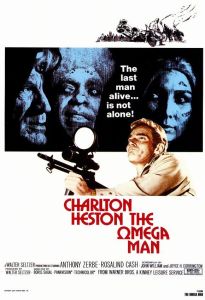 In 1971, Charlton Heston starred in The Omega Man, based on the novel I am Legend by Richard Matheson. If that sounds familiar to you, it is the same name as the 2007 movie I am Legend starring Will Smith. There was also a 1964 adaptation called The Last Man on Earth starring Vincent Price. In any case, Heston’s version is, to me, the true representation of the novel. It’s about Dr. Robert Neville (Heston) the sole survivor of a plague that killed or turned most of the population into zombie-like creatures. His blood held the key to curing the victims and also vaccinating other survivors. This movie had many firsts, including the first interracial kiss between Heston and co-star Rosalind Cash as Lisa. Another great aspect of the film was the empty streets of Los Angeles. They filmed in downtown LA on a Sunday morning to show the post-apocalyptic, deserted streets. Though the movie only got a 55% rating on
 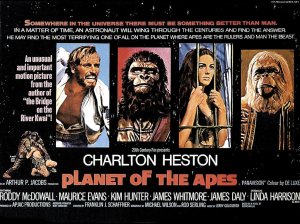 The last movie is the 1968 classic Planet of the Apes and it’s sequel, Beneath the Planet of the Apes. As astronaut George Taylor, Heston and his team’s space flight takes them more than 2000 years into the future where apes now rule and humans are mute slaves. Of course, you don’t find this out until the end of the movie when you see the classic image of the Statue of Liberty, rusted and torn apart on the shoreline. This movie hits on a big theme of that era, equality and racism, but this time, it’s the humans being discriminated against. The movie was the first for large-scale make-up effects for all the actors cast as apes. Heston shines in his role as the only talking human in a world of talking apes. His arrogance, vanity, and narcissism comes through in his tough-guy persona as he struggles to survive. He also has to share time with the late great Roddy McDowell, who starred in all five Planet of the Apes movies. In the end, though, this is one of Heston’s most memorable roles.
 The end of the world has been prophesied since the dawn of time. The Mayans said the world would end on December 21, 2012. The Vikings called it Ragnarök when the world ends and the Norse Gods die, only to be reborn. Of course, the book of Revelation in the New Testament goes into detail about the end of the world and the second coming of Jesus; and with the current climate of financial, political and global upheaval happening today, people are scared that our time has come.
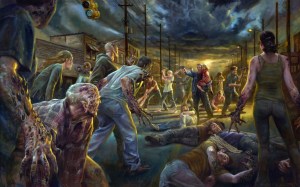 As writers, the end of the world can come about through endless possibilities and that gives us so many options in the stories we tell: Zombie apocalypse, machines taking control, deadly viruses, nuclear war, climate change, etc. We are fatalistic in our views of the apocalypse and show humanity at its worst to bring about the end of the world. Yet, through all that turmoil and tribulation, we find a glimmer of hope. There is always one guiding light or shining star that wins out in the end and gives everyone, from readers to storytellers alike, that spark of optimism that will inspire.
 Disney is known for its great animated movies, the majority of which take place in the fantasy genre. Classics like Snow White and the Seven Dwarfs, Sleeping Beauty and The Sword in the Stone have all the right elements of a great fantasy movie: wizards and witches, dragons and knights, good versus evil, etc. There is one, however, that was a beautiful adaptation of a classic fantasy novel that Disney decided was too dark and scary and swept it under the rug of forgotten classics. I am, of course, referring to The Black Cauldron.
 The imagery in this movie was quite dark and spooky, especially for a kid’s animated movie. The Horned King looked like a walking corpse. It had all the earmarks of a Disney movie with the boy hero, a beautiful princess, the evil villain and his henchmen, and of course, the comedic sidekick; but even with all that, Disney had problems with the film. After its initial audience screening, the Disney Studio chairman Jeffrey Katzenberg ordered massive edits and cuts in the film, particularly in the “cauldron born” scene where the Horned King brings his army of the dead to life. There was even scenes where one of the “cauldron born” monsters sliced the neck of one victim and the torso of another. It was very gruesome indeed.